2026.10.12
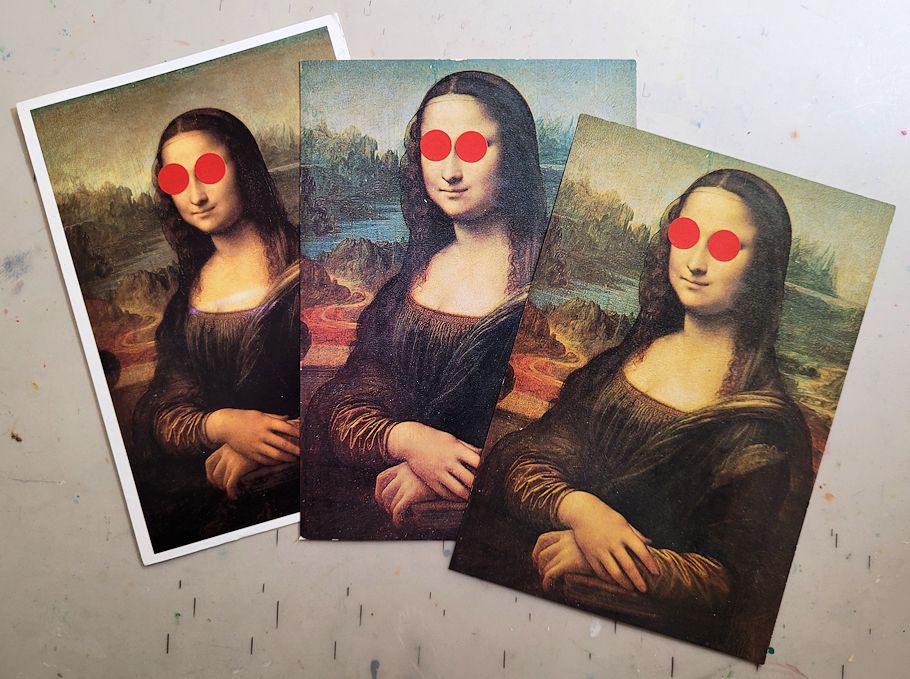
Unbekannt I'm sold on the idea 2026.10.12
2025.10.12
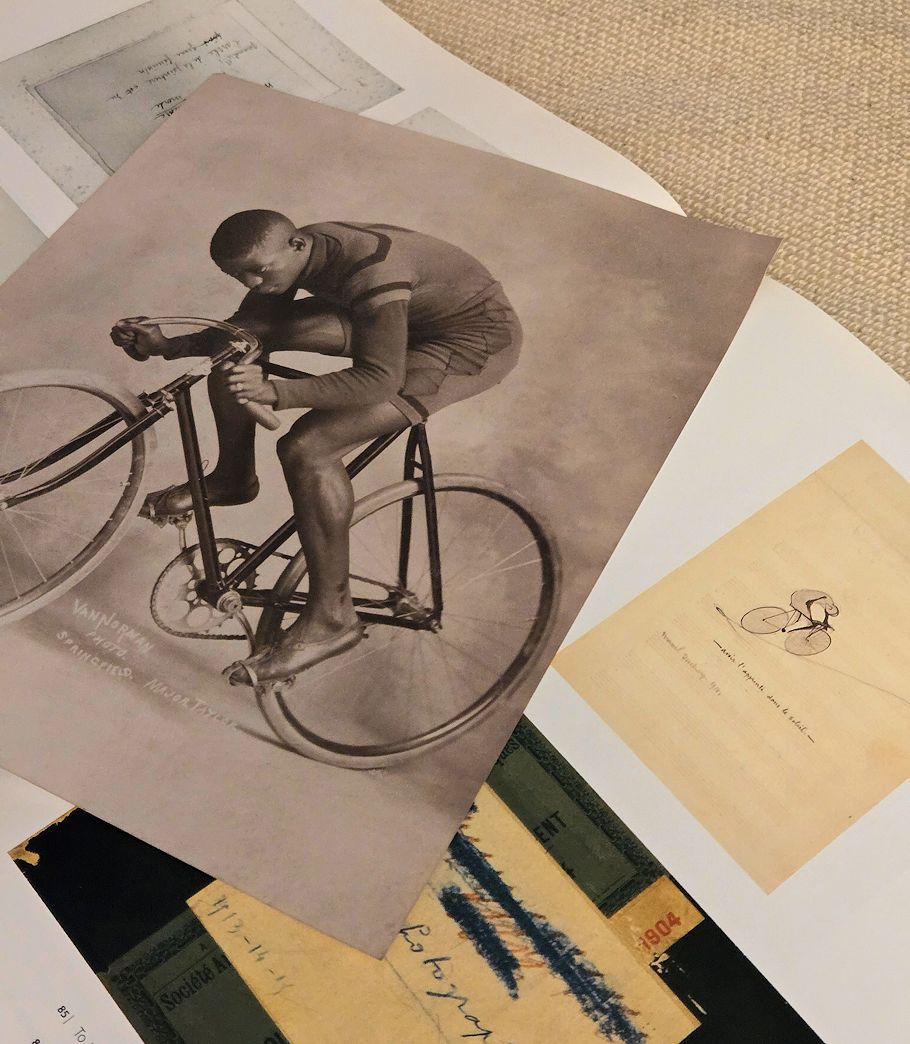
Unbekannt ...wonders if this is the first time these two images have been photographed together 2025.07.27
So far, I have found no reference connecting Marshall "Major" Taylor with the work of either Alfred Jarry or Marcel Duchamp, yet, at this point, the connection appears explicitly obvious. Moreover, the now obvious connection begs the question, why has this connection never been noted before? And ultimately, do Jarry's and Duchamp's covert references to Marshall "Major" Taylor have anything to do with race and/or racism, or were Jarry and/or Duchamp simply covetous of Taylor's unprecedented modern fame?
Stephen Lauf, Duchamp After Unbekannt (2025.10.11), p. 0006s.
hare_on_fire Yes! Duchamp’s possible inspiration for his bicyclist drawing appears to have been from the photo of Marshal Taylor. A Great story that seems more suitable to Harper’s readers than the Art infidels of IG.
451.rhawn.gallery hare, thanks again. Your comments always inspire me to think further. First, this story is most aimed at the entrenched academics of art history, the self appointed gate keepers. And now, thinking further, I see Duchamp, after the great notoriety of NUDE DECENDING NO 2 in early 1913, getting a taste of Taylor's fame. The first readymade, BICYCLE WHEEL of later 1913, is Duchamp's trophy for himself, and in early 1914 Duchamp shows himself as an apprentice to Taylor's way.
Elstowe Manor


Another happy afternoon touring a Horace Trumbauer designed residence.
Philadelphia Art Museum
 
451 Rhawn Gallery is very proud to now represent the Quondam Philadelphia Museum of Art!
2024.10.12
451 Rhawn Gallery
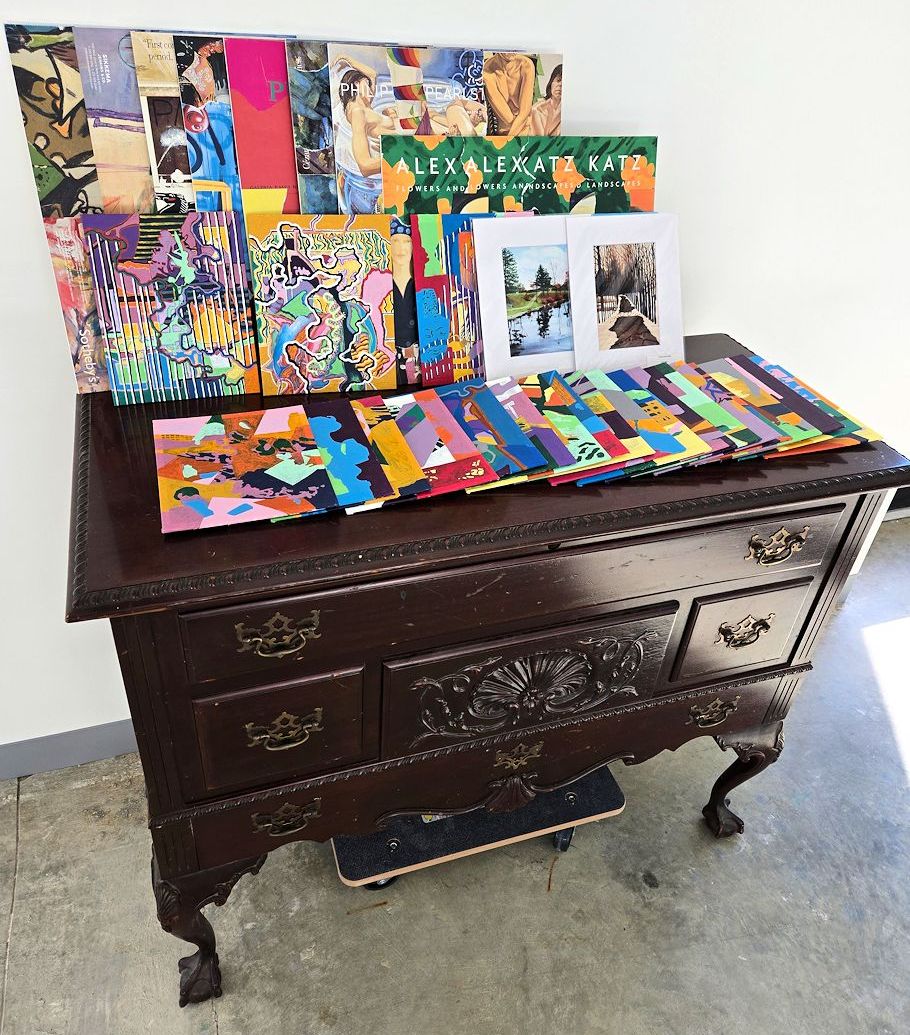
2023.10.12
From The Discovery of Piranesi's Final Project:
12 October 2023 Thursday
From ges-2.org/projects/star-vengeance:

"In creating the design of the exhibition, its architects Yura and Katya Plokhov relied on the ideas of the architectural theorist Stephen Lauf, the author of the concept of "The Timepiece of Humanity," in which the body of the "Vitruvian Man" is interpreted as a historical gauge. In the exhibition, you can see an illustration to the original gauge/diagram from the text, as well as listen to selections of Lauf's texts through headphones."
"The construction of the exposition is almost completed..."


I'm not entirely sure, but I believe this is where The Timepiece of Humanity gauge will be displayed.
Bianconi's Doctoring Piranesi next season: "lacuna repletea"
2022.10.12
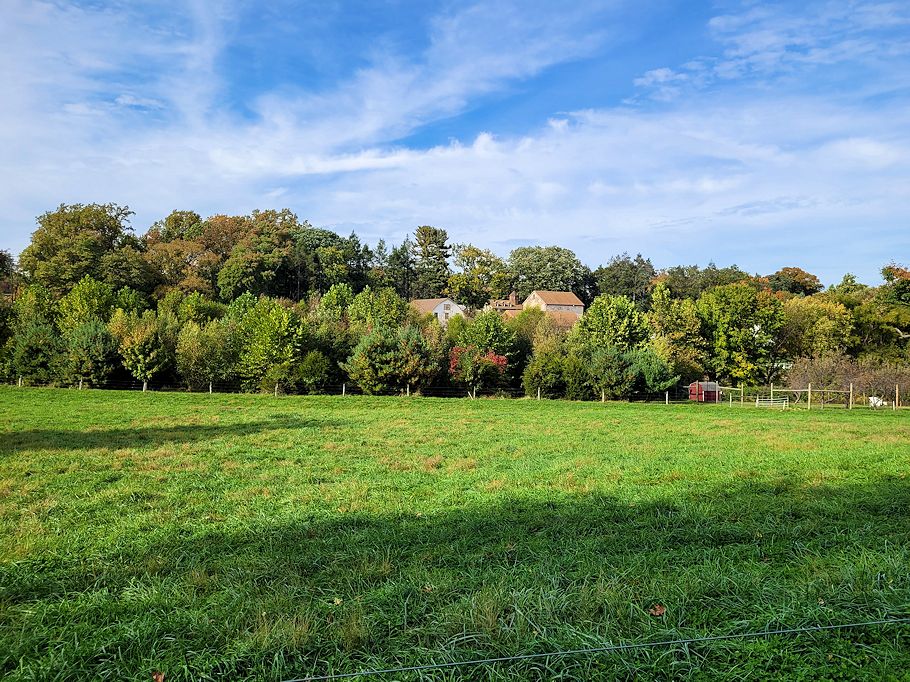
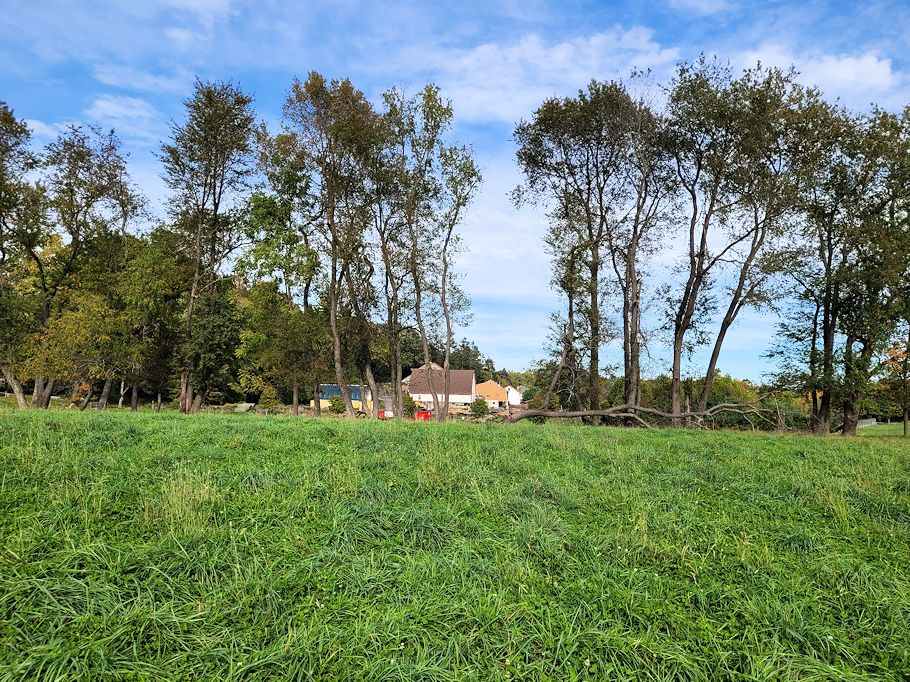
Fox Chase Farm

2021.10.12

20211012_2055.jpg
2005.10.12
Phenomenology
Daniel Birnbaum, "The Hospitality of Presence: Problems of Otherness in Husserl's Phenomenology" in Peter Weibel, Olafur Eliasson: Surroundings Surrounded.
I read Birnbaum's essay last night and it appears that Husserl would have benefited from the realization that all memory (both his 'primary memory' and his 'secondary memory') are by default mental reenactments. That Husserl ultimately saw perception and primary memory (ie, retention) as the same (ie, simultaneously present and thus together constituting the nature of presence itself) then unwittingly suggests that perception is also a mental reenactment of the phenomenon being perceived.
[My first philosophy teacher (in high school 1973-74) was big into Husserl. He occassionally went off on these tangents talking about his experiences at the Husserl center (or whatever it was called) somewhere in Germany (if memory/mental reenactment serves me correctly).
Otto King of Bavaria died eighty-nine years ago yesterday, so I wondered if anything coincidental or interesting might happen. I wasn't really expecting anything though because my mind was working 'elsewhere', yet it was the work on a new artwork regarding Marcel Duchamp that led me to recall that Otto's death date was yesterday--Duchamp died 2 October 1968. Finally, it was last night while watching E=mcsquared on PBS that I then recalled Art that is Otto and Einstein at Princeton 5 March 2000. One of my favorites--
 
In case you don't get it, Otto (the name itself even) supplies the symmetry, while Einstein supplies the relativity.
Edmund Husserl was born in Moravia. The Odds of Ottopia, I suppose.
 
The most beautiful definition I've ever read...
"So what then is architecture? Is it a hard, 'simple', 'natural' protective shell that engenders the continuation of life? Or is it a soft formlessness forever redesigning an applied shell it doesn't naturally have?"
QBVS 1, p. 148.
Crazy names
According to my notes, on 18 August 1996 I was still referring to the virtual museum of architecture I was then planning to 'create' as non ici [literally 'not there' in Latin], and by 2 October 1996 the virtual museum was being referred to as Quondam. What happen in-between these two dates was a phone conversation with Susan M. Dixon, a friend from our mutual architecture school days and now an Art Historian whose Ph.D. work was on Piranesi's archaeological publications. Sue and I had many conversations back then regarding a virtual museum of architecture and Piranesi's Campo Marzio. It was Sue that suggested the name "quondam" for the virtual museum of architecture. She had once heard reference to a Professor Quondam in Rome, and the name/word had since stuck in her mind. I liked the name immediately.
2002
Denis Diderot "Encyclopedia"
Diderot, Denis. "Encyclopedia." The Encyclopedia of Diderot & d'Alembert Collaborative Translation Project. Translated by Philip Stewart. Ann Arbor: Michigan Publishing, University of Michigan Library, 2002. http://hdl.handle.net/2027/spo.did2222.0000.004 (accessed 12 October 2026). Originally published as "Encyclopédie," Encyclopédie ou Dictionnaire raisonné des sciences, des arts et des métiers, 5:635–648A (Paris, 1755).
11/192
A general analytical dictionary of the sciences and arts cannot, therefore, be the work of a single man. I will go farther: I do not think it can be the work of any of the literary or scientific societies now existing, either separately or collectively.
12/192
The French Academy would furnish to an encyclopedia only that which pertains to the language and its usage; the Académie des Inscriptions et Belles-Lettres, only knowledge relative to profane history, ancient and modern, chronology, geography and literature; the Sorbonne, only theology, sacred history, and superstitions; the Academy of Sciences, only mathematics, natural history, physics, chemistry, medicine, anatomy, etc.; the Academy of Surgery only the art of that name; the Academy of Painting, only painting, engraving, scupture, design, architecture, etc.; the university only what is understood by humanities, the school of philosophy, jurisprudence, typography, etc.
13/192
Survey the other societies I may have omitted, and you will see that, each one being concerned with a particular object, which doubtless belongs in the purview of a universal dictionary, they leave aside an abundance of others which should be included in it; and none of them will supply you with the breadth of knowledge you require. Go further, and require each of them to make a contribution: you will see how many things are still missing, and you will be obliged to get the assistance of a large number of men who belong to different classes, priceless men, but to whom the gates of the academies are nonetheless closed because of their social station. All the members of these learned societies are more than is needed for a single object of human science; all the societies together are not sufficient for a science of man in general.
14/192
Doubtless what one would obtain from each separate society would be very useful, and what they would supply would greatly advance the universal dictionary towards its realization. There is even one task which would bring their efforts back to the purpose of this enterprise and which should be imposed upon them. I distinguish two means of cultivating the sciences: one is to contribute to the sum of knowledge through discovery, and this is the way one merits the name of inventor; the other is to compare discoveries and reorganize them, so that more men are enlightened, and each may participate, according to his abilities, in the enlightenment of his times; and what are called classical authors are those who succeed in this genre, which is not without its difficulties. I concede that, were the learned societies throughout Europe to set themselves to collecting ancient and modern knowledge, connecting it, and publishing complete and methodical treatises, one would only be the better for it; at least let us judge that by its effects. Let us compare the twenty-four quarto volumes of the Academy of Sciences, compiled in accordance with the prevailing spirit of our most celebrated academies, to eight or ten volumes composed as I conceive the project, and see whether the choice could be in doubt. The latter would contain a huge amount of excellent material dispersed through a large number of studies, where it remains unproductive of any useful sensation, like scattered embers which will never constitute a glowing fire; and of those ten volumes, the most prolific academic collection would constitute at most a few. Have a look at the Mémoires de Academy of Inscriptions and Belles-Lettres, and figure how many could be used for a scientific treatise. What can I say of the Philosophical Transactions, and the Actes des curieux de la nature? In any case, all these enormous collections are precarious; and there is no doubt that the first anthologist with taste and ability will bring them down. Such was to be their ultimate fate.
15/192
Having seriously reflected on it, I find that the specific object of an academician might be to perfect the branch to which he had adhered, and to immortalize himself through writings which would not be those of the academy, which would not be a part of its collections, which he would publish under his own name; but the academy ought to take as its purpose to assemble all that has been written on every subject, synthesize it, illuminate it, concentrate it, order it and publish treatises in which each item would take up only the space it deserves, and would have only the importance that could not be denied it. How many reports, which fatten our collections, would provide not a line for such treatises!
16/192
What an encyclopedia should do is supplement the execution of this project, extended not only to the various objects of our academies, but to every branch of human knowledge: an opus that can only be carried out by a society of men of letters and artists, dispersed, each concerned with his own division, and joined together only by the general interest of humankind, and by a feeling of mutual beneficence.
17/192
I say a society of men of letters and artists in order to assemble every talent. I will have them dispersed, because there is no existing society from which one can draw all the knowledge that is needed, and because, if you wanted the project to be forever in the making and never completed, you could do no better than to create such a society. Each society has its assemblies, the assemblies are separated by intervals of time, they last only a few hours, part of that time is lost in discussions, and the simplest objects occupy months on end; whence it will transpire, as one of the Forty was saying, who deploys more wit in conversation than many authors in their writings, that when the twelve volumes of the Encyclopedia have all been published we will still be on the first letter of our dictionary; whereas, he added, if those working on it held encyclopedic sessions, as we hold academic sessions, we would reach the end of our opus while they were still on the first letter of theirs; and he was right.
18/192
I add, men joined together only by the general interest of humankind, and by a feeling of mutual beneficence , because these being the most excellent motivations that can prompt men of good will to action, they are also the most durable. You can take pride personally in what you are doing; you stir yourself up; you undertake for your colleague and friend what no one would attempt for any other consideration; and I dare to say, based on experience, that the outcome of these attempts is certain. The Encyclopedia has assembled its materials in a rather short time. It is not base interest that has united and hastened the authors; they have seen their efforts abetted by most of the men of letters from whom they had reason to expect some assistance; and they have been deterred in their labors only by those who had not the necessary talent to contribute a single good page to them.
19/192
If the government participates in such an opus, it will not get done. It should use its influence only to favor its execution. With a single word, a monarch can make a palace arise from the grass; but a society of men of letters is not like a herd of manual laborers. An encyclopedia cannot be ordered up. It is a labor that must be doggedly pursued rather than launched energetically. Enterprises of this nature are incidentally proposed in courts, by way of conversation; but they never arouse enough interest to avoid being forgotten amidst the tumult and confusion of countless other more or less important matters. Literary projects conceived by the great are like leaves that grow out in the spring, dry up in the fall, and fall in endless succession in the forests, where the nutrients they supply to a few useless plants is their only noticeable effect. Among countless examples of every kind of which I have knowledge, I will cite just one. There was a proposal for experiments on the hardness of wood. The idea was to strip the bark off trees, and let them die standing. They were stripped, died standing, and probably were cut down; in other words, everything was done, except experiments on the hardness of wood. And how could they have been performed? There were to be six years between the time the first orders were given and the final procedures. If the man on whom the sovereign had depended should happen to die, or lose favor, the work is suspended, and never resumed, since a minister does not generally adopt his predecessor's plans, even though they would bring him, if not greater glory, at least rarer glory than that of having initiated them. Individuals hasten to reap the rewards of expenses they have incurred; government is in no such economic hurry. For some reprehensible reason, the prince is dealt with less honestly than his subjects. Men make minimal commitments, and demand the highest recompense. The uncertainty of whether the work will ever be of any utility causes unbelievable indolence among the workers; and to add to the handicaps all the force possible, projects commanded by sovereigns are never conceived in function of utility, but always of the dignity of the person, which is to say that they are overextended, difficulties mount up; to surmount them, men, talents, and time are required in proportion, and ultimately a revolution almost necessarily occurs which proves the fable of the Schoolmaster. If the average lifetime of man is less than twenty years, that of a minister is less than ten. But it is not only that interruptions are more frequent, they are also even more damaging to literary projects, when the government is running them, than when they are run by individuals. An individual at least picks up the remains of his enterprise: he carefully sets aside materials that may serve at some more favorable moment; he tries to salvage his investment. The monarchical spirit disdains such prudence. Men die, the fruits of their waking nights disappear, and one cannot discover what has become of them.
20/192
But the fact which should lend the greatest weight to the considerations just set forth, is that an encyclopedia, like a vocabulary, has to be begun, continued, and completed within a certain amount of time, whereas sordid self-interest always tries to prolong projects ordered by kings. If one employed for a universal and analytical dictionary the long years which the scope of such an object seems to require, that dictionary would be, thanks to the intervening revolutions, which are scarcely less rapid in the sciences than in the arts or languages, the dictionary of a previous century, just as a vocabulary slowly compiled could only be that of a bygone reign. Opinions grow old and disappear like words; the interest taken in certain inventions wanes by the day, and vanishes; if the project drags out, long discussions of temporary matters will no longer be pertinent; others, whose place is past, will go unmentioned: a problem we have ourselves experienced, even though no great interval has elapsed between the date of this opus and the moment I write. The reader can perceive the most disagreeable irregularity in a work destined to represent, in proper proportion, the state of things throughout all previous time; important objects stifled; small ones overblown: in a word, the opus will constantly become disfigured in the hands of its workers; it will deteriorate more from the simple passage of time, than it will ever be perfected through their efforts, and become more deficient and weak by virtue of what ought to be shortened, or dropped, or corrected, or added to, than rich from what it will progressively gain.
2002.10.12
"What the Hand Knows"
The following are the first two paragraphs, etc. of "What the Hand Knows" by Calvin Tompkins. This articled first appeared in The New Yorker, 2 May 1983, and very much spurred my attitude toward CAD and its relationship to draftsmanship and manual dexterity in general. It also very much stimulated the initiation of my 'career' as an artist. For the record, I received CAD training February 1983, and CAD equipment was delivered to Cooper and Pratt Architects (my employers then) April 1983.
What the Hand Knows
One of our era's significant feats has been the separation of art from skill. In most English dictionaries, the two words are closely linked. "Art" spreads a wider net, of course; it is so variable in meaning that, according to Webster, it can be used as a synonym for "skill," "cunning," "artifice," and "craft"--"which, on the other hand, are not always synonymous among themselves." When it comes to the creation of works of art, most people would agree that something more than skill, cunning, artifice, and craft is required. Only in this century, however, has it been found possible and desirable to produce works of art whose making requires little skill or none whatsoever.
Marcel Duchamp is generally thought to be the hero (or the villain, if you prefer) of this remarkable achievement. Duchamp's famous "ready-mades"--common manufactured objects, such as an iron bottle-drying rack and a snow shovel, selected and signed by the artist--undermined the whole tradition of the artist as a skillful maker while poking fun at the belief that artists were superior beings whose mere signature conferred value. Duchamp's ambition, as he explained it, was "to put painting once again at the service of the mind." European painting since Courbet had been primarily "retinal," he said--a matter of manual skill in applying paint to canvas. By choosing a factory made object of no aesthetic interest, which he might alter slightly or else leave untouched, Duchamp was calling attention, in his ironic way, to the fact that a work of art was also an intellectual act--a choice, a sum of decisions. (Years later, when an art historian taxed him with the fact that several of his ready-mades had in the course of time become highly prized works of sculpture--icons reproduced in all the art-history books--Duchamp smiled and said, "Nobody's perfect, hm?"
[Five paragraphs later:]
Anyone who goes around to the galleries these days, however, is bound to see a great deal of deliberately unskillful, clumsy-looking work. Jean Michel Basquiat, Keith Haring, and the other "graffiti artists" who have shifted their efforts from subways to shows in New York galleries and international "trend" exhibitions are much talked about this season, and the European and American neo-expressionists are still the hot ticket in SoHo. This slapdash, loosely figurative painting is usually viewed as a triumphant reaction to the austerities of Minimalism and Conceptualism. Perhaps it is; perhaps that is all it is. David Hockney, the English artist, has been saying recently that representational art was bound to make a comeback sooner or later; the reason its return took the form it has taken in neo-expressionist, "new image," and graffiti art, he said, is that these artists were never trained to draw. Some of our young geniuses gain an appearance of free hand drawing by projecting photographic images on their canvases and tracing them; the photograph is, among other things, an invaluable substitute for skill. [Note: almost 20 years later Hockney makes well researched claims that even some older masters used projections to draw!]
When the CAD computer equipment finally arrived and was up and running at Cooper and Pratt Architects, we had one of those not-too-serious office competitions for naming the computer. I suggest we call it 'Duchamp' while Bernie (my CAD partner then) suggested 'Godot' (as in "Waiting for Godot"). As it happened, both Bernie's and my suggestion turned out to be fitting.
What I personally experienced when CAD became my daily occupation was the sudden obsolescence of my (quite talented) drafting skills. I still used my hands to "draw," but my dexterity now amounted to making sure I pushed the right buttons--my mother very presciently at the time made the analogy to playing the piano. I started seeing the final drawings produced by either pen-plotter or electrostatic printer as sort of "ready-mades" or at least abundantly reproducible "originals" that I could merely add a signature to in order to confer them as "my" drawings.
Luckily (and thanks to the words of Calvin Tomkins, I guess), I found an outlet for my quondam drafting skills in producing "art." I decided, however, that I no longer needed to exhibit skill because I had (access to) a machine that did that, thus I produced art that was (and sometimes still is) deliberately unskillful, intending to prove through such imperfect manifestations themselves that a hand indeed created the work.
If nothing else, all of the above explains why a few years ago here at design-l I wrote that "perhaps it is more the case that the way we think influences the way we use tools."
1999.10.12

pieces/palimpsest 31
1994.10.12
2D CAD data
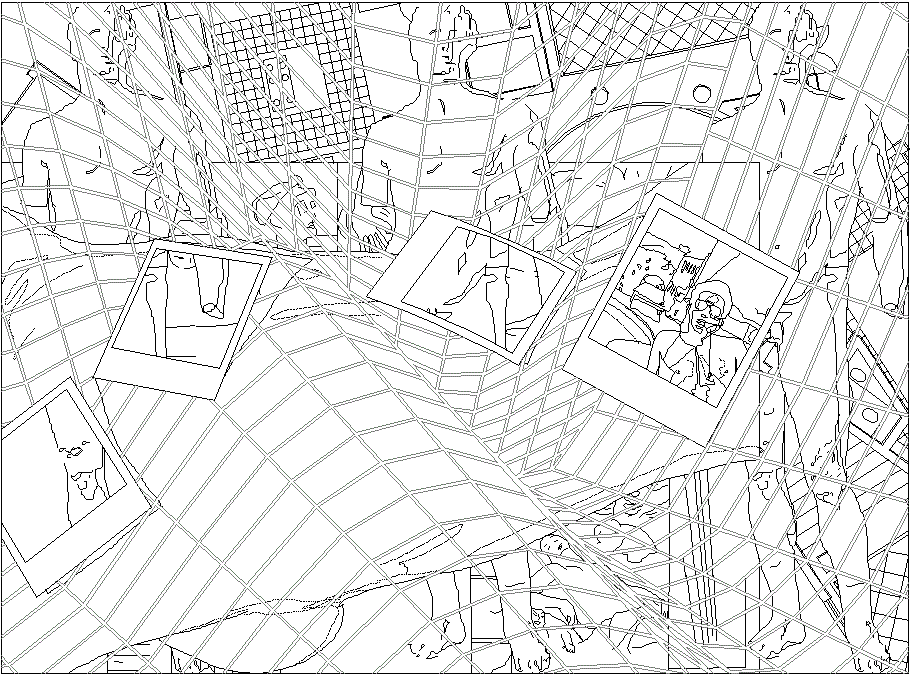
94101201.db Watercolor Series 1
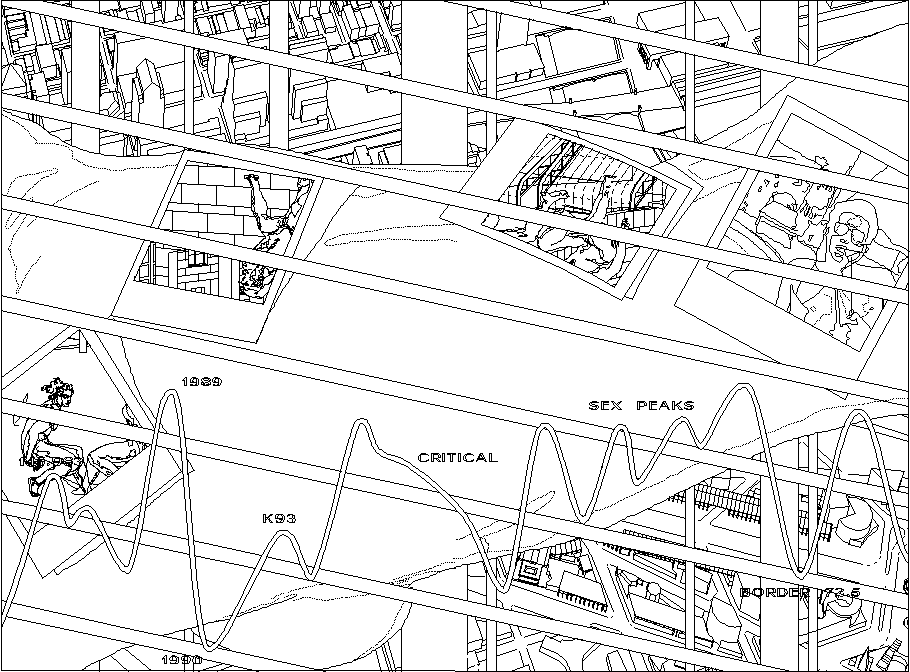
94101202.db Watercolor Series 2
1967.10.12
1967. Thursday, Neuilly-sur-Seine
Marcel writes to Brookes Hubachek and encloses Ektachromes of two paintings by Jacques Villon, a study for Les Grands Fonds, painted at La Brunié [16.7.1940], and a portrait, neither of which has been "on the market". Proposing that the Art Institute of Chicago or one of the trustees might be interested, Marcel explains that Villon gave the pictures to Georges Herbiet [10.6.1963], "a very close friend of the family," who now needs the money.
Armed with photographs of the wooden chessmen which Duchamp carved in Buenos Aires [22.6.1919], Arturo Schwarz comes to measure the originals.
After her telephone call [5.10.1967], Monique Fong visits the Duchamps at 5 Rue Parmentier.
Ephemerides
1958.10.12
1958. Sunday, New York City
Receives a telephone call from Monique Fong.
Ephemerides
1947.10.12
1947. Sunday, New York City
At midnight Marcel calls at the Kieslers' apartment at 56 Seventh Avenue and stays for an hour.
Ephemerides
1936.10.12
1936. Monday, Paris
At Hans Arp's request, Duchamp mails two copies of the Green Box [16.10.1934] to Mrs Norton in London. Writing to advise her of the minimum sale price in England and the amount she owes him, Duchamp asks Mrs Norton whether she is interested in having some Rotoreliefs [30.8.1935], the discs which she may have seen at the Surrealist show in London [11.6.1936].
Ephemerides
|