2026.10.13
the Piranesis' French texts, not...
...the "Good and Ill Fortunes of Piranesi's Theoretical Texts"
[Duboy begins here with an unwitting referential connection to Duchamp's last day.]
Anaglyphe, anaglypte (Gr. Anagluphos, carved in relief). Originally: A work carved in low relief. -- In modern usage: an ornamental inscription in which signs retain their phonetic and orthographical value and are arranged to suggest an independent theme. -- A procedure for producing stereoscopic prints, two images being printed or projected in complementary colours, usually green and red. -- Juxtaposition on one sheet of two drawings thus differently coloured which, viewed through two coloured eyeglasses, give a sensation of three-dimensional vision in relief; anaglyphs are used in spatial geometry.
Dictionnaire Larousse
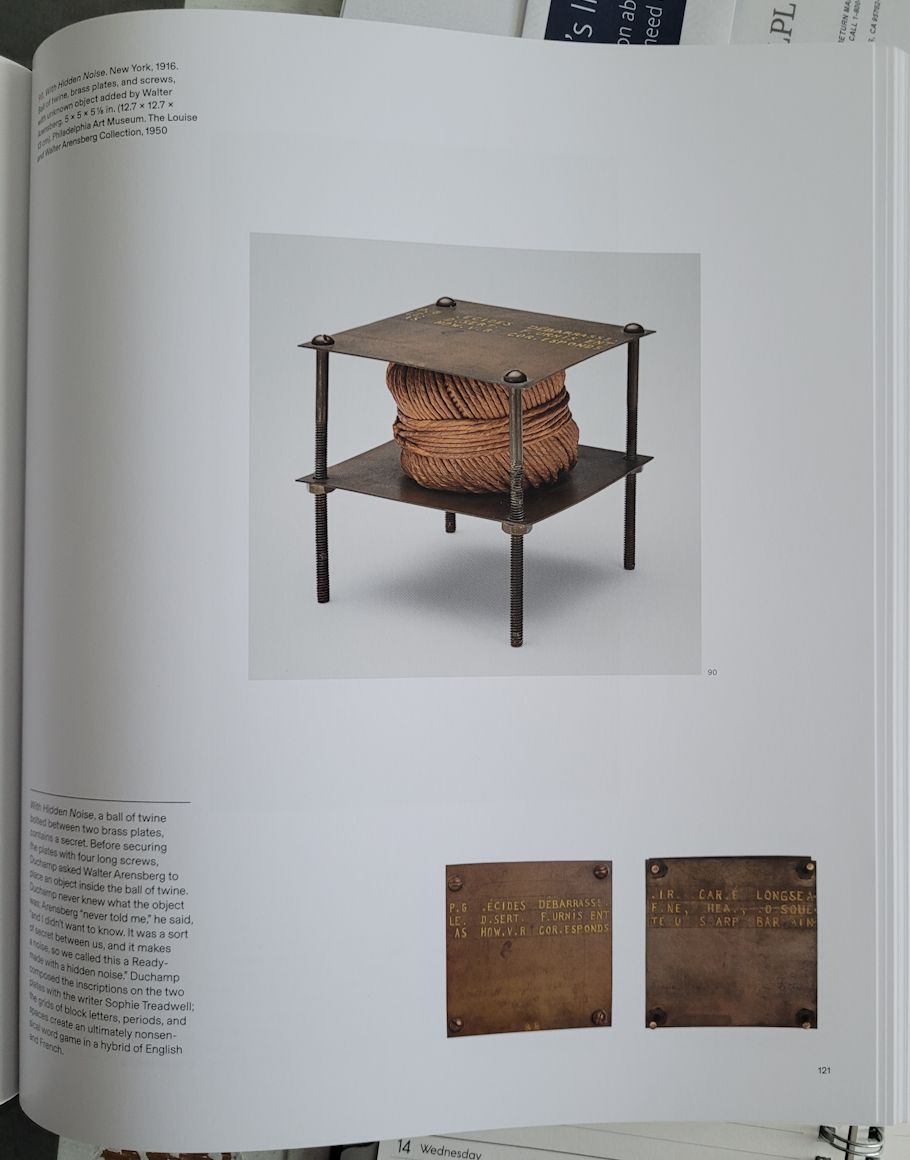
Marcel Duchamp With Hidden Noise New York 1916
I told Cynthia the story behind With Hidden Noise, and also told her I doubt it's never been opened to see what's inside. She took a closer look and said, "Yeah, it's only held together with screws."
Later, as we were going through the hall of readymade reenactments, Cynthia noticed a reenacted With Hidden Noise, and with a big smile asked, "What do you suppose is hidden in that one!?"
"
What a great question!"
We proceeded to ask the retired philosophy/history professor guide that was standing nearby. He did not know the answer, but said he would bring up the question at the next guide learning session. Turns out the guides throughout the exhibit took many prior classes on Duchamp along with analyzing a specific Duchamp work of their choice, and our guide chose Woman Hack-Driver--
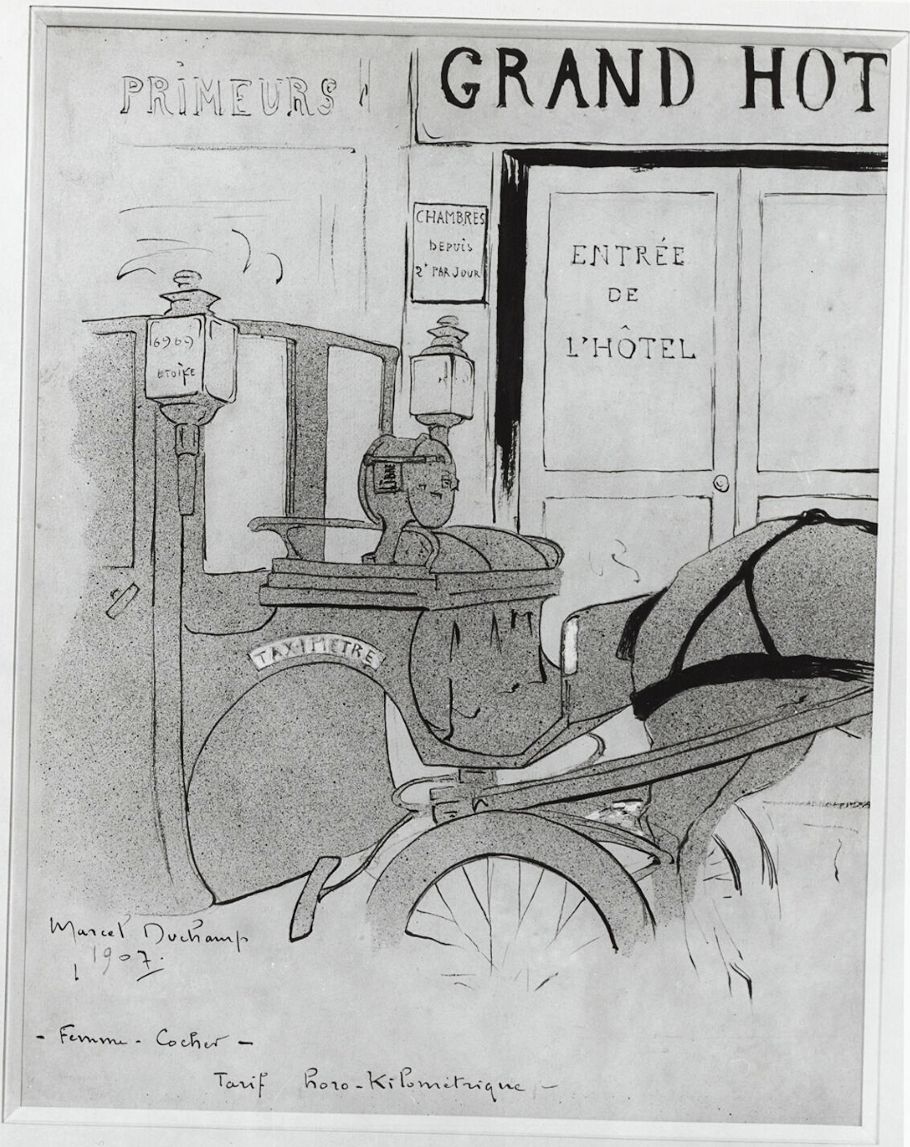
Marcel Duchamp Woman Hack-Driver Paris 1907
--"That's where I see it all started for Duchamp. ... Once you see that the 'Grand Hot' is really a brothel and that the metered taxi is really a prostitute, then it makes sense of everything that followed."
"Wow, what you described for us is just like an anaglyph. ... Duchamp spent the last day of his life searching for and ultimately finding a book about anaglyphs he remembered from years before."
Marcel Duchamp was 20 years old in 1907.
Jean-Jacques Lequeu was 20 years old in 1777 studying at Ecole Gratuite de Dessin, Peinture et Architecture of the Acedémie des Sciences, Belles-Lettres et Arts de Rouen, where Lequeu's project that year was to design a sharecropper's farm. (Duchamp also received his formal education in Rouen.)
Francesco Piranesi was 20 years old in 1778 when he inherited his father's business in Rome, where his first act as new proprietor was to publish Différentes vues de quelques Restes de trois grands Edifices qui subsistent encore dans le milieu de l'ancienne Ville de Pesto autrement Posidinia qui est située dans la Lucanie, the first Piranesi production to be titled, captioned and annotated entirely in French.
From The Discovery of Piranesi's Final Project:
1 December 1778 Tuesday

Vüe des restes interieurs du Temple de Neptune. Nous ne nous etendrons pas à donner un détail de ces morceaux, parce qu'ils seront bien détaillés, et bien specifiés dans les Planches suivantes. Dans ce Frontispice nous les avons dessinés telsqu'ils éx istent áf fin d'en presenter un grand appareil uni à d'autres amas de ruines, que nous donnerons ci apres dans les Planches. Les Voyageurs connoisseurs assurent, que par rapport á l'Architecture Grecque des Temples bâtis dans l'Ordre Dorique, ceux de Pesto sont superieurs en beautè á ceux, qu'on voit en Sicilè et dans la Grece, et que sans se donner la peine, et la fatigue de longs voyages, ceux ci peuvent suffire pour contenter la curiositè, et qu'enfin cette grande, et majestueuse Architecture donne en son genre l'idée la plus parfait de ce bel Art. Franciscus Piranesi fecit
View of the interior remains of the Temple of Neptune. We will not extend to give a detail of these pieces, because they will be well detailed, and well specified in the following Plates. In this Frontispiece we have drawn them as they exist in order to present a large apparatus united with other piles of ruins, which we will give hereafter in the Plates. Knowledgable Travelers assert that, compared to the Greek Architecture of the Temples built in the Doric Order, those of Pesto are superior in beauty to those seen in Sicily and Greece, and that without taking the trouble, and the fatigue of long journeys, these may suffice to satisfy the curiosity, and that finally this great, and majestic Architecture gives in its kind the most perfect idea of this beautiful Art.
2021.10.13
Pennypack Park
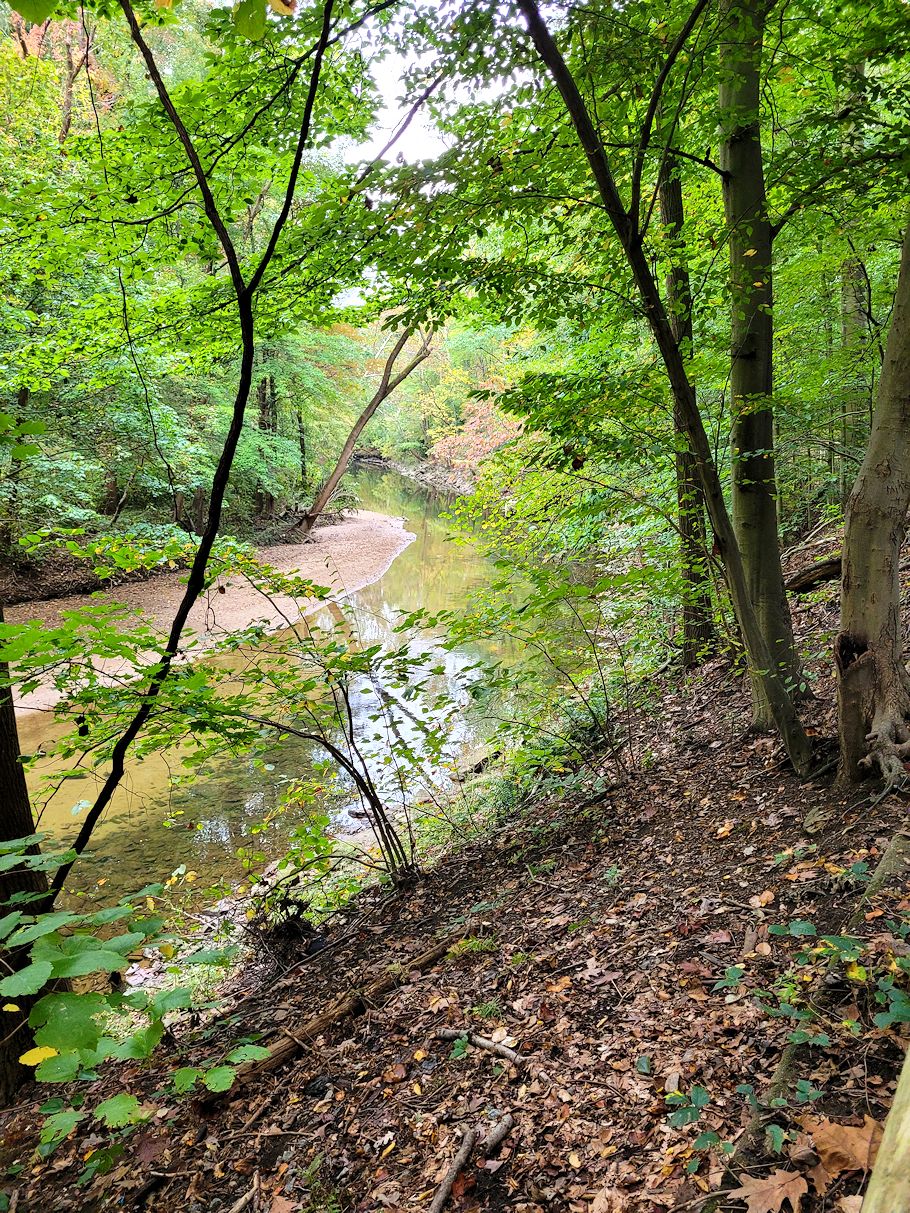
2008.10.13
omnifrequence
"All the world's a next stage."
2002
Denis Diderot "Encyclopedia"
Diderot, Denis. "Encyclopedia." The Encyclopedia of Diderot & d'Alembert Collaborative Translation Project. Translated by Philip Stewart. Ann Arbor: Michigan Publishing, University of Michigan Library, 2002. http://hdl.handle.net/2027/spo.did2222.0000.004 (accessed 13 October 2026). Originally published as "Encyclopédie," Encyclopédie ou Dictionnaire raisonné des sciences, des arts et des métiers, 5:635–648A (Paris, 1755).
21/192
What diversity is not daily introduced into the language of the arts, machines, and techniques! If a man spends part of his life in the description of the arts; if, discouraged by this tiring work, he allows himself to be diverted to more entertaining and less useful occupations, and his earlier work remains in its folders, twenty years will not have elapsed before, in lieu of the new and curious things, fascinating by dint of their strangeness, interesting because of their applications, the prevailing taste, or their temporary importance, he will find nothing but incorrect notions, outdated techniques, crude or abandoned machines. In the several volumes he finally composes, there will be not one page that does not require revision; and in the multitude of illustrations he has had engraved, scarcely a figure that does not require redrawing. They are portraits the originals of which no longer exist. Luxury, father of the arts, is like the Saturn of the fable, who took pleasure in destroying his children.
22/192
The revolution may be less pronounced and less noticeable in the sciences and liberal arts than in the mechanical arts; but there is one. If you look at dictionaries of the last century, you will find under the word aberration nothing of what our astronomers mean by this term; on electricity, that productive phenomenon, there will be scarcely a few lines and even then they will be just false notions and old prejudices. How many terms are there in mineralogy and natural history of which one could say as much? If our dictionary had come a little sooner, we would have been liable to repeat with respect to Ear-cockle, a wheat disease, to grain diseases, and their trade, the errors of centuries past, because the discoveries of M. Tillet and the system of M. Herbert are recent.
23/192
When we treat of beings in nature, what better can we do than to list scrupulously all their known properties at the moment when we write? But observation and experimental physics, constantly multiplying phenomena and facts, and rational philosophy, comparing and combining them, extend or contract constantly the boundaries of our knowledge, and consequently introduce variations in the meanings of our established words, render the definitions we had of them inaccurate, false, and incomplete, and even require us to establish new ones.
24/192
But that which will lend the opus an outdated feel, and cover it with scorn, is above all the revolution that will take place in men's minds, and in the national character. Now that philosophy is rapidly advancing; that it submits all the objects within its jurisdiction to its power; now that its tone is the prevailing one, and we are beginning to shake off the yoke of authority and example to hold to the laws of reason, there exists hardly a single elementary and dogmatic work with which we can be wholly satisfied. We find these productions imitate those of men, and not nature's truth. We dare raise doubts against Aristotle and Plato; and the time has come when works which still enjoy the highest reputation will lose some of it, or will even be forgotten; certain genres of literature which, for want of real life and actual practices to serve as their models, are incapable of an invariable and reasonable poetics, will be neglected; and others which will remain, sustained by their intrinsic value, will take on an entirely new form. Such is the effect of the progress of reason; progress which will overturn so many statues, and redress some which have been overturned. These are the statues of rare men who have come ahead of their time. We have had, if I may speak thus, contemporaries in the century of Louis XIV.
25/192
Time, which has dulled our taste for questions of criticism and controversy, has made a good part of Bayle's dictionary insipid. There is no author who has lost so much in certain places, and gained more in others. But if such was the fate of Bayle, think what would have happened to the Encyclopedia of his time. With the exception of Perrault and a few others, whose merit the versifier Boileau was not in a position to appreciate – La Mothe, Terrasson, Boindin, Fontenelle -- under whom reason and the philosophical or doubting spirit made such progress, there was perhaps not a man who could have written a single page of it which one would deign to read today. For let there be no mistake: there is a great difference between giving birth out of pure genius to a work celebrated by a whole nation which has its moment, its taste, its ideas and its prejudices, and setting forth the poetics of the genre, in accordance with a real and thoughtful knowledge of the human heart, the nature of things, and right reason, which are the same in every era. Genius knows no rules, and yet it never departs from them in its successes. Philosophy knows only the rules founded on the nature of beings, which is immutable and eternal. The last century furnishes us examples; it is up to ours to prescribe the rules.
26/192
The knowledge that was least widespread in the last century is becoming more so by the day. All women who have received some education are able to use with discernment every expression devoted to painting, sculpture, architecture, and letters. How many children are there who can draw, who have learned geometry, who are just as familiar with the language of the arts as with their native language, and who say an agreement, a beautiful form, an agreeable shape, a hypotenuse, a fifth, [26] a Triton, an arpeggio, a microscope, a telescope, a focus, the same as they would say an opera glass, a sword, a cane, a carriage, or an ostrich feather? Minds are also swept along in another general movement toward natural history, anatomy, chemistry, and experimental physics. The expressions belonging to these sciences are already quite common, and will inevitably become more so. What will result from all this? That even the popular language will change its appearance; it will be extended as our ears become accustomed to the words through the felicitous applications that are made of them. For if one reflects on it, most of these technical words that we use today were at the outset neologisms ; it is usage and time which have removed that equivocal overtone. They were clear, energetic, and necessary. The metaphorical meaning was not far removed from the literal one. They were descriptive. The relations on which the new usage was based were not too farfetched; they were genuine. The figurative sense did not seem a subtlety; moreover, the word was harmonious and flowing. The main idea was linked to others which we never recall without instruction or pleasure. On such bases are founded the fortune of these expressions; and the opposite causes are those of the discredit into which will fall and have fallen so many other expressions.
27/192
Our language is already quite extensive. Like all others, it has owed its formation to need, and its riches to flights of the imagination, to the constraints of poetry, and to the numbers and harmony of oratorical prose. It will make great strides under the power of philosophy; and if nothing halted the advance of the mind, in less than a century an oratorical and poetic dictionary of the century of Louis XIV, or even our own, would contain scarcely two-thirds of the words that will be in use by our descendants.
28/192
In a vocabulary, in a universal and analytical dictionary, in any work designed for the general instruction of men, one must therefore begin by framing one's object from the most extensive dimensions, understand the spirit of the nation, possess a sense of its direction, outpace it, so that it will not leave your work behind, but on the contrary meet up with it ahead; one must determine to work only for the following generations, because the moment of our existence passes, and a great enterprise will barely be completed before the present generation has passed on. But in order to be useful and new for longer, by getting further ahead of the national spirit which is constantly progressing, it is necessary to shorten the duration of the labor by expanding the number of collaborators: a means which moreover is not without its disadvantages, as we shall see further along.
29/192
Yet knowledge does not and cannot become common beyond a certain point. In truth, we do not know what this limit is. We do not know how far a given man can go. We know even less how far the human race would go, what it would be capable of, if it were not halted in its progress. But revolutions are necessary; there have always been revolutions, and always will be; the greatest interval from one revolution to another is known: this cause alone limits the extension of our work. There is a point in the sciences beyond which it is almost beyond their ability to go. When that point is reached, the achievements that remain of that advance are forever a marvel to the entire species. But if the species is limited in its efforts, how would the individual not be in his? The individual has only a certain amount of energy in his faculties, animal as well as intellectual; he only lasts for a time; he necessarily respects cycles of labor and rest; he has needs and passions to satisfy, and is exposed to endless distractions. Whenever all that is negative in these quantities adds up to the smallest possible sum, or all that is positive adds up to the largest, a man applying himself all alone to some branch of human science will take it as far as it can be taken by the efforts of a single individual. Add to the labor of that extraordinary individual that of another, and so forth, until you have filled the interval between one revolution and the one furthest removed, and you will have some notion of what the entire species could achieve, especially if you assume, as favoring its work, a certain number of auspicious circumstances that would have lessened the success had they gone against it. But the general mass of the species is able neither to follow nor to know this progress of the human mind. The highest point of instruction it can attain has its limits: whence it follows that there will be books that will forever be above the common ken of men; others will gradually drop beneath it, and still others will have both fates.
30/192
To whatever level of perfection an encyclopedia may be brought, it is evident from the nature of the work that is will necessarily be in the latter category. There are objects which are in the hands of the people, from which they draw their subsistence, the practical knowledge of which is their constant concern. Whatever treatise one may write about it, there will always come a moment when they know more about it than the book does. There are other objects about which they will remain almost entirely ignorant, because their gains in knowledge are too small and too slow, even if we assumed it is continuous, ever to amount to much enlightenment. Thus both the man of the people and the scientist will always have equally as much to desire and instruction to find in an encyclopedia . The most glorious moment for an opus of this nature would be that which immediately follows some great revolution which has suspended the progress of the sciences, interrupted the labors of the arts, and plunged a portion of our hemisphere back into darkness. What gratitude the next generation following such troubled times would feel for the men who had feared them from afar, and taken measures against their ravages by protecting the knowledge of centuries past! Then you would see (I say this without vainglory, because our Encyclopedia will perhaps never attain the perfection that would earn it such honors) that that great opus would be named along with the monarch under whom it was undertaken, the minister to whom it was dedicated, the powerful who favored its execution, the authors who devoted themselves to it, all the men of letters who took part in it. The same voice that recalled these supporters would not forget to evoke as well the burdens the authors had to bear and the affronts to which they were subjected; and the monument that would be elevated to them would have several sides, which would represent by turns the honors accorded their memory, and the marks of indignation attached to the memory of their enemies.
2002.10.13
3D CAD data
   
021013a.db Venue with "Primarily Not Duchamp" model
Primarily Not Duchamp: an exhibition of work by Stephen Lauf at VENUE November 1993. The exhibition title refers specifically to the cracks in THE LARGE GLASS. A postcard invitation to the exhibit was sent to Anne d'Harnoncourt, but she never paid the exhibit a visit. Several works from the exhibition were purchased, with two of those pieces today most likely somewhere on Harris Island, Scotland.
1993.10.13

Studs

Prenuptial
1963.10.13
1963. Sunday, Pasadena
Marcel acquired the brown straw hat with a tartan band in Las Vegas during the week. After the opening of the exhibition [8.10.1963], Bill Copley invited Teeny and Marcel to fly to the desert oasis for twenty-four hours with Richard Hamilton, Betty Asher, Walter Hopps and Betty and Monte Factor. "We did have fun," revealed Teeny. "Went to the best hot shows and all the most amusing gambling dens..." A souvenir photograph of the group was taken while they dined at the Stardust and in an hour of amusement at the Golden Nugget, Marcel (who didn't gamble himself while he was in Las Vegas) directed Hopps' placing of chips on the gaming tables from time to time as they sat chatting. Gradually Marcel became more specific in
his instructions and Hopps realized that "winning numbers were coming up with increasing regularity". When Marcel said "it was a nice time to stop", Hopps initial stake of $20 had increased more than a hundredfold.
The day after returning from Las Vegas, the brown straw hat with a tartan band accompanied Marcel to the early morning photographic session with Julian Wasser at the museum where, in the centre of the room with the Large Glass, he played chess with brave Eve Babitz who willingly stripped bare for him. Hat in hand, Marcel was then interviewed by Francis Roberts in Hopps' office.
During his long conversation with the journalist, Duchamp mentions that La Broyeuse de Chocolat [8.3.1915] appears in many places in his work: "Always there has been a necessity for circles in my life, for, how do you say, rotation. It is a kind of narcissism, this self-sufficiency, a kind of onanism. The machine goes around and by some miraculous process I have always found fascinating, produces chocolate."
The brown straw hat is with Marcel again today. On his second visit to Ojai [15.4.1949], Beatrice Wood gives a lunch party for Marcel at McAndrew Road, her home since 1954. As well as Ram Pravesh Singh, who accompanied Beatrice to the special preview [7.10.1963], the guests are Walter Hopps, Berty Asher, Richard Hamilton, a Japanese couple and Harriet von Brerton. Later they have tea at the Esther Baur Gallery, Santa Barbara, before returning to Pasadena.
Ephemerides
1954.10.13
1954. Wednesday, Philadelphia
In a week of celebration for the Louise and Walter Arensberg Collection [28.12.1950], now installed in the galleries [23.8.1954], inaugurated on Monday with a special press view and open to the public from Saturday, George Widener, the chairman of the trustees of the Philadelphia Museum of Art, gives a magnificent dinner, to which the Duchamps are invited.
Ephemerides
|