2026.02.24
early hours experimentation, etc.
Having now read the first two chapters of Robert Lebel's Marcel Duchamp (1959), I hence suspect "The Creative Act", a short speech Duchamp delivered at the Convention of the American Federation of Arts, Houston, Texas 5 April 1957, and subsequently published within Lebel's Marcel Duchamp as well, is a direct byproduct of Duchamp's close collaboration with Lebel in 'creating' (c. 1953-59) the Marcel Duchamp book. Essentially, I wonder whether Duchamp would even have had the confidence and wherewithal to write "The Creative Act" were to not for the collaborative 'creation' of the Marcel Duchamp book in the first place. Here's the last paragraph of "The Creative Act": "All in all, the creative act is not performed by the artist alone; the spectator brings the work in contact with the external world by deciphering and interpreting its inner qualifications and thus adds his contribution to the creative act. This becomes even more obvious when posterity gives its final verdict and sometimes rehabilitates forgotten artists."
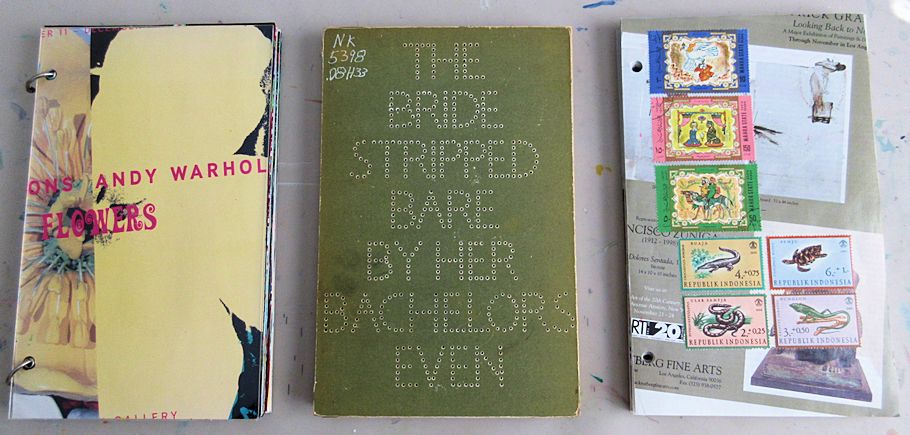
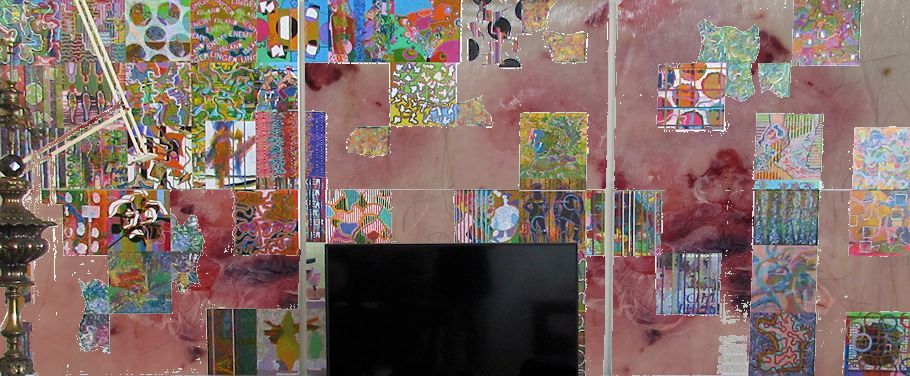
Shortly before noon, and upon finishing "1912: Around the World of Painting in Eight Months", the second chapter of Lebel's Marcel Duchamp, it occurred to me to see if the pages of the originally titled flowers stamped (c. 2005-) are the same size as Hamilton's The Bride Stripped Bare By Her Bachelors, Even (1960)--they're virtually identical, but for the differential of mere millimeters in either direction. And, later today, I'll begin to investigate whether it's a good idea to complete This One's for George (November 2023-) with images of bullous pemphigoid 'attacking' his body (the last year-and-a-half of his life), or the last two images of George, 15 minutes after his death.
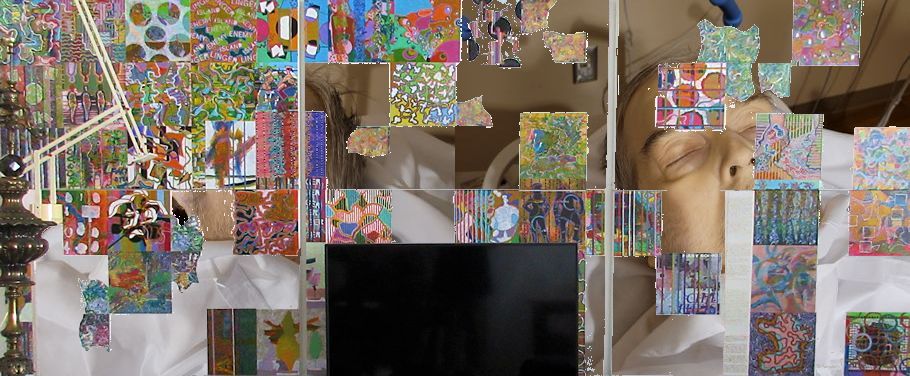
2025.02.24
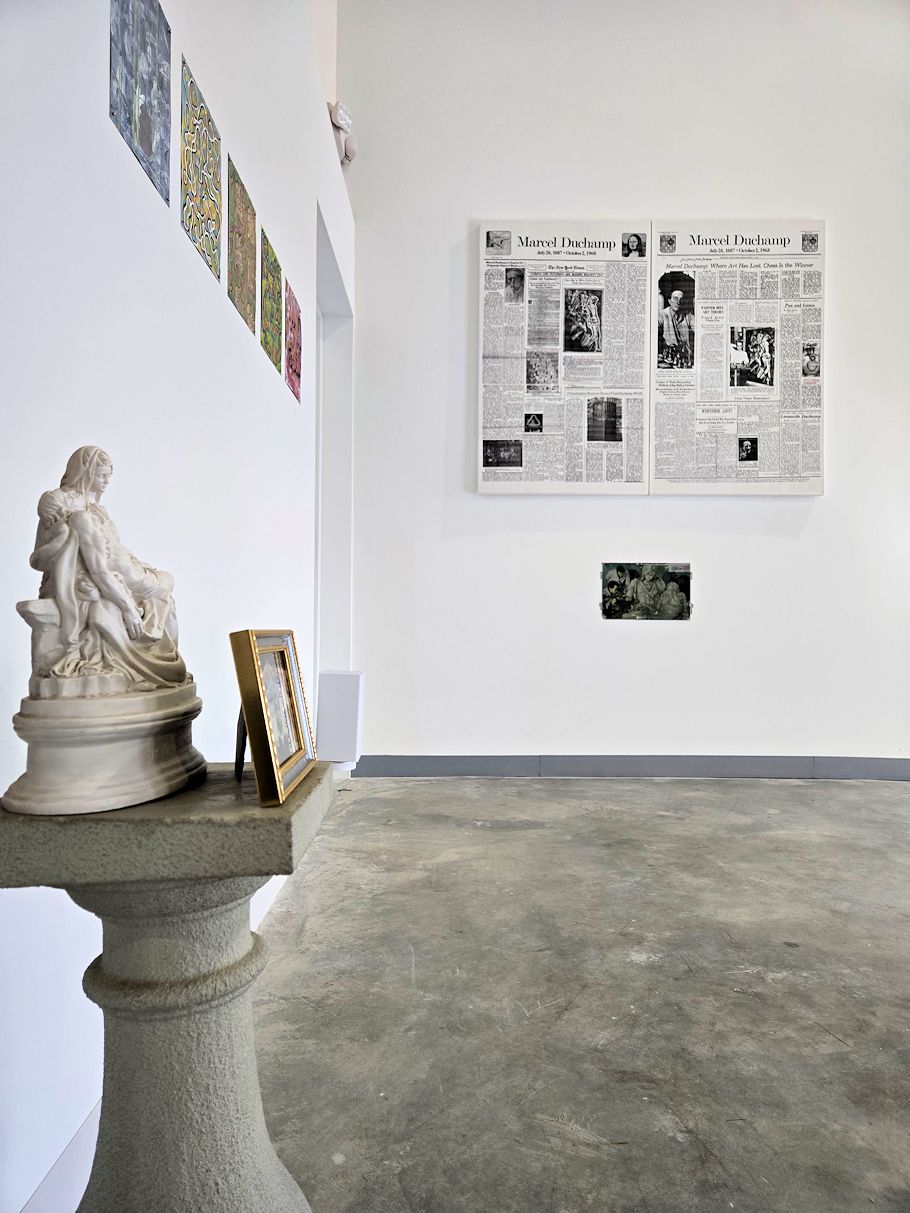
His Alter Ego . . . A Perfume Bottle in the background
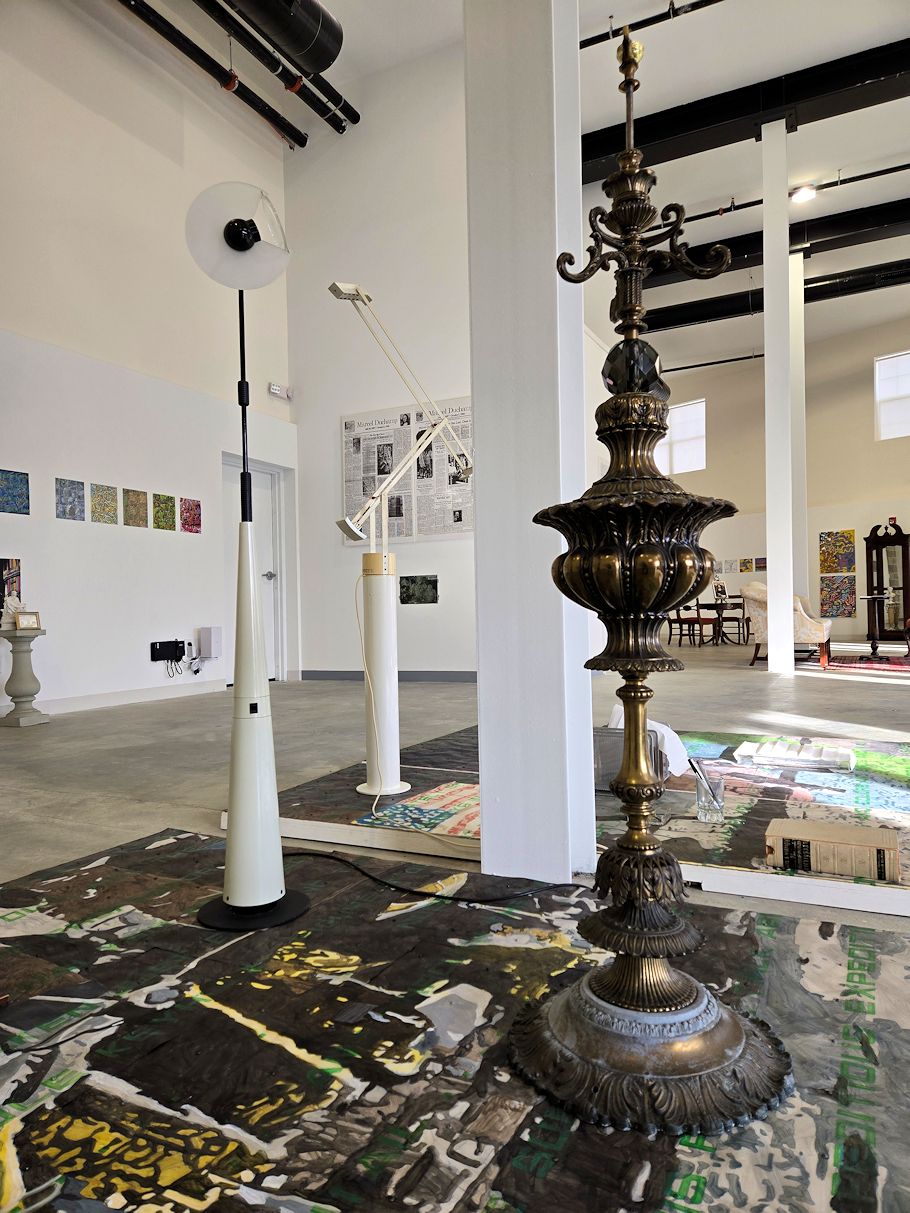
Genesis 1:3
2024.02.24
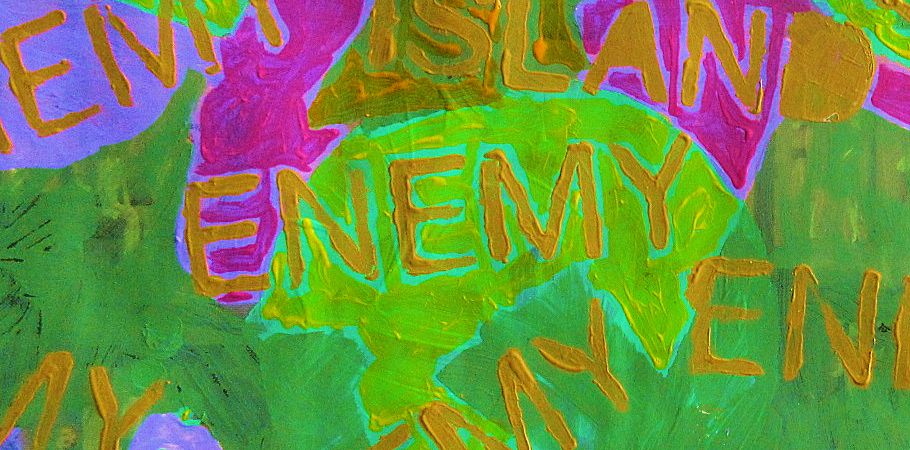
16:40
2017.02.24
08:13
2015.02.24

Virtual Painting 176
2009.02.24
pragmatists turning political?
What you describe relates more to schizophrenic situations, i.e., states characterized by the coexistence of contradictory or incompatible elements, rather than to bilocational situations.
Coexistence and bilocation are not the same thing.
Schizophrenia is a whole split.
Bilocation is two of the same whole.
2006.02.24

Husker Du Haus

Husker Du Haus, too
2003.02.24
Re: Cremaster Cycle
We celebrate an artist's unique vision and his/her ability to execute that vision. Yet we also (less explicitly) celebrate an artist's ability to be sold (i.e., the exchange of significant amounts of money). The irony comes in when in reality an artist that isn't sold will most likely never be celebrated for their unique vision and their ability to execute that vision.
As Mike Kelley inadvertently(?) points out in Foul Perfection, there are at least two active art worlds that make up ongoing art history—those that play by the 'club' rules and then those that are (either) heretics, apostates, revolutionaries, etc.
How much difference is there now-a-days between contemporary art history and the record of what art sold/sells well?
1999.02.24
Re: irrational architecture
The Campo Marzio is a very cleverly designed time-capsule, and it's a coded message in virtual stone.
1995.02.24
chronosomatics
…the kidneys is where I first found out about metabolism… …metabolism’s initiating role in the concept of a developing human imagination. The upper organs of the digestion manifest a predominantly metabolic age for mankind.
1959.02.24
1959. Tuesday, New York City
For the exhibition at the Sidney Janis Gallery to mark the publication of the "de luxe" edition of Robert Lebel's book [12.2.1959], Duchamp writes to Henri Marceau requesting the loan of three works from the Philadelphia Museum of Art: Nu descentant un Escalier, No.3 [29.4.1919], Mariée [25.8.1912], and Cimetière des Uniformes et Livrées, No.1 [19.1.1915]. Duchamp adds that the English edition of the book is due to appear shortly and he wonders if the museum would be interested in having a certain number of copies at the wholesale price.
Ephemerides
|