2026.10.15
Philadelphia Museum of Art
2025.10.15
 
   
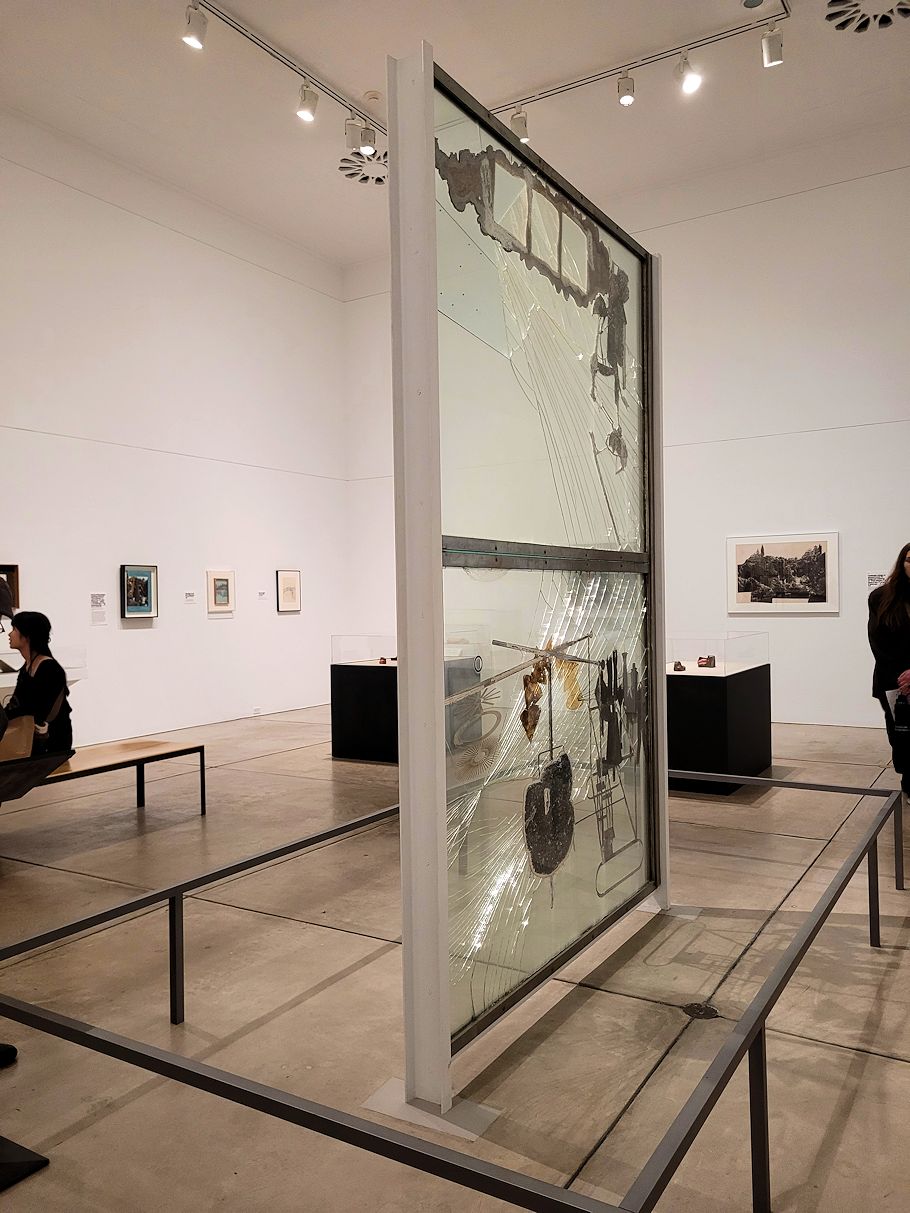
In Bicycle Wheel, we may recognize a three-dimensional version of Chocolate Grinder, which in turn is reproduced in the Large Glass where, as we have seen, it is the mechanomorphic expression of the Bachelor. Another connection between this Readymade and Chocolate Grinder becomes apparent when we recall that in both cases we are dealing with a "bachelor machine." We recall that the protagonist of the Glass "grinds his chocolate himself"; in the same way, riding a bicycle is a solitary activity in the Bachelor, as is revealed by the sketch To Have the Apprentice in the Sun, included in The Box of 1914.
Arturo Schwarz, The Complete Works of Marcel Duchamp (2000), p. 188.
"The Armory Show wasn't well accounted for in Paris," Duchamp recalled. "I don't think there was even a newspaper account of it, except for short notes." Duchamp himself, isolated in his Neuilly studio did not learn until weeks later that he had become famous in America.
That his fame derived from a single painting must have made it all the more astonishing. What was it about Nude Descending a Staircase, with its somber colors and utter lack of prurient interest, that excited such an enormous furor? "Her room was mobbed everyday," according to one authoritative account. "People formed queues, waiting for thirty, even forty minutes just to stand momentarily in her presence, venting their shocked gasps of disbelief, their rage or their raucous laughter before giving way to the next in line."
. . .
Duchamp always maintained that the reactions to his Nude had to do mainly with its title, and in the United States this certainly seems to have been the case. Nudes weren't supposed to come down stairs in art, and paintings weren't supposed to have their titles written on the canvas, either, and any artist who broke the rules in such an irreverent manner must be kidding, right?
. . .
Although the sales must have done something for Duchamp's ego, they did not change anything so far as he was concerned. "It came from so far away!" as he said, and besides, it was "a local success. I didn't attach mush importance to it."
Calvin Tomkins, Marcel Duchamp: A Biography (1996), pp. 116-118.
2024.10.15
451 Rhawn Gallery

2023.10.15
From The Discovery of Piranesi's Final Project:
15 October 2023 Sunday
Gave future art works a lot more thought today than I have in a long time. It may all start happening again once the "final project" concludes 9 November. In any case, things are already starting to shift.
The closest, geographically, I've yet come to southern Ukraine and Russia is just outside of Konin, Poland, where my father's father is buried. That was May 1990.
Is Piranesi's final project even an issue anymore? I've pretty much 100% made a very plausible case. My explanation as to why Piranesi changed all his already etched ancient circus plans holds together exceptionally well. I wonder how long it will take for that to be admitted to.
2017.10.15
 17101503.db GAUA 101 102 104 plans site plan models
2002
Denis Diderot "Encyclopedia"
Diderot, Denis. "Encyclopedia." The Encyclopedia of Diderot & d'Alembert Collaborative Translation Project. Translated by Philip Stewart. Ann Arbor: Michigan Publishing, University of Michigan Library, 2002. http://hdl.handle.net/2027/spo.did2222.0000.004 (accessed 15 October 2026). Originally published as "Encyclopédie," Encyclopédie ou Dictionnaire raisonné des sciences, des arts et des métiers, 5:635–648A (Paris, 1755).
41/192
If I were asked which, of the Greek and Latin languages, is to be preferred, I would answer neither; my opinion is that they both should be used: Greek for anything that Latin cannot express, or would not offer equivalent expression for, or one less exacting; I would have Greek serve only to fill in the gaps in Latin, and this simply because familiarity with Latin is more widespread: for I concede that if we were to choose on the grounds of richness and abundance, there would be no hesitation. The Greek tongue is infinitely more extensive and expressive than Latin; it has a plethora of terms which bear the evident imprint of onomatopoeia: countless notions which have signs in that tongue have none in Latin, because it appears the Latins did not rise to any level of speculation. The Greeks had burrowed into all the depths of metaphysics of the sciences, the fine arts, logic, and grammar. With their idiom anything can be said; they have all the abstract terms relative to the operations of the understanding: witness Aristotle, Plato, Sextus Empiricus, Apollonius, and all those who wrote on grammar and rhetoric. In Latin one is often hindered by the lack of expressions: it would have taken the Romans several more centuries to integrate abstractions into their language, at least to judge by the progress they made while still under the discipline the Greeks; for in any case a single man of genius can cause ferment among a whole people, abbreviate the centuries of ignorance, and carry knowledge to a point of perfection with a surprising rapidity. But this observation does not efface the truth I am advancing: for if we count the men of genius, and distribute them over the entire span of centuries past, it is evident that there will be few of them in each nation for each century, and that almost none will be found who has not improved the language. Creative men bear this distinctive trait. Since it is not merely by leafing through the writings of their contemporaries that they find the ideas they need to use in their own writings, but sometimes rather by delving deep into themselves, at other times by bursting outside themselves, and studying more attentively and more profoundly the natures about them, they are obliged, especially at the origin of languages, to invent signs to represent exactly and forcefully what they are the first to discover. It is the fire of the imagination and deep contemplation that enrich a language with new expressions; it is keenness of mind and the severity of dialectic that perfects its syntax; it is the flexibility of the speech organs that makes it more supple; it is the ear's sensitivity that makes it harmonious.
42/192
If we decide to make use of both languages, we will first write the French radical, and beside it the Greek or Latin radical, with the quotation of the ancient author from whom it was taken, and where it is used, according the definition closest to the meaning, force, and other accessory notions which must be determined.
43/192
I say the ancient radical , even though it is not impossible that a primary term, radical and undefinable in one language, may have neither of these characteristics in another: in which case it seems plain to me that with one of these peoples the human mind has made more progress than with the other. We do not yet know, it seems to me, to what extent a language is a rigorous and faithful image of the exercise of reason. What prodigious superiority one nation acquires over another, especially in the abstract sciences and the fine arts, from this single difference! And how far the English are still behind us, on the sole consideration that our language is made, and they are not yet thinking about fashioning theirs! Precision in the exact sciences, taste in the fine arts, and consequently immortality in works in that genre, depend on the perfection of the idiom.
44/192
I have specified citation of the place where the Greek and Latin synonym was used, because a single word often has several meanings; because need, and not philosophy, having dictated the formation of languages, they have had and always will have this common defect; but because a word has but one meaning in a cited passage, and that meaning is certainly the same for all peoples to whom the author is known. ????? ?e?de, ?ea? , etc. Arma virumque cano, etc. have but a single translation in Paris or Peking: therefore nothing is so misguided as for a Frenchman who knows Latin to learn English from an English-French dictionary, instead of having recourse to an English-Latin dictionary. Even if the English-French dictionary were written or corrected according to the invariable, common measure, or even based upon great familiarity with the two languages, there would be no way to tell; you would be required at each word to rely on the good faith and insight of your guide or his interpreter, whereas by using a Greek or Latin dictionary, you are enlightened, satisfied, reassured by the application; you compose your own vocabulary thanks to that single means, if there be one, that can replace direct intercourse with the foreign nation whose idiom you are studying. I speak, moreover, from my own experience: this method has worked well for me; I consider it a sure means of acquiring in little time very accurate notions for correctness and vigor. In a word, an English-French dictionary and an English-Latin dictionary are like two men one of whom, in telling you about the dimensions or the weight of a body, would assure you that it weighs or measures, and the other, instead of assuring you of anything, would take a yardstick or scale, and weigh or measure it before your eyes.
45/192
But what shall the recourse of the nomenclator be in those instances where the common measure fails him? I reply that a radical being by nature the sign of a simple, specific sensation, or of an abstract general idea, the instances where a common measure will be wanting cannot but be rare. But in those rare instances, one must absolutely rely on the discrimination of the human mind: we must hope that by dint of seeing an undefined expression employed with the same meaning in a large number of definitions in which this sign will be the only unfamiliar one, its value will soon be surmised. There is in ideas, and consequently in signs (for one is to the other as an object to the mirror that repeats it) a close bond, such a correspondence; each emits a light which they reflect back and forth so intensely that, if you know the syntax, and the faithful interpretation of all the other signs is given, or you have an understanding of all the other ideas that go into a sentence, with a single exception, it is impossible not to succeed in determining the exceptional idea or the unknown sign.
46/192
Known signs are so many given conditions for the solution of the problem; and however brief the discourse or how few terms it contains, it hardly seems that the problem could remain among those which have several solutions. Evidence for this lies in the very small number of places where we fail to understand ancient authors: if those places are examined, it will become clear that the obscurity arises either from the writer himself whose ideas were not precise, or the corruption of the manuscripts, or our ignorance of the customs, laws, mores, or some other such cause; never from the indeterminacy of the sign, whenever that sign has been employed with the same meaning in several different places, as necessarily occurs with a radical expression.
47/192
The most important point in the study of a language is doubtless the knowledge and meaning of its terms. Yet that leaves spelling, and pronunciation without which it is impossible to sense the full merit of harmonious prose and poetry, and which consequently must not be entirely neglected, and that aspect of spelling we call punctuation . It has happened, through alterations in rapid succession in the manner of pronouncing, and corrections which are slowly introduced into the manner of writing, that pronunciation and writing fail to coincide, and although there are among the most civilized peoples of Europe societies of men of letters whose responsibility it is to moderate and change them, and bring them closer together, they end up remarkably far apart; so that of two things one of which has only been invented, at the outset, for the purpose of faithfully representing the other, the latter is no less different from the former than portraits of the same person painted at two widely separated ages. Finally the problem reached such exaggerated proportions that no one dared try to remedy it. We pronounce one language, and write another; and we become so accustomed for the rest of our lives to this oddity that caused such tears when we were children, that if we gave up our bad spelling for one closer to pronunciation, we would no longer recognize the spoken language in its new combination of letters.
48/192
But one must not be stopped by these considerations that are so powerful on the multitude and momentarily. One absolutely must constitute a descriptive alphabet, in which the same sign does not represent different sounds, nor different signs the same sound, nor several signs a vowel or a single sound. Next we must determine the value of these signs for the most rigorous description of the different movements of the speech organs in the production of the sounds attached to each sign; distinguish with the greatest precision sequential movements from simultaneous ones; in a word not shrink from minute detail. Famous authors who have written on ancient languages have not refused to take this trouble for their idiom; why should we not do the same for ours which has its original authors in every genre, is expanding daily, and has practically become the universal language of Europe? When Molière made light of grammarians, he was stepping outside his philosophical character, and he did not know, as Montaigne would have said, that he was slapping the writers he respected the most, on the cheek of the Bourgeois Gentilhomme.
49/192
We have but one means for fixing transitory but purely conventional things: it is to compare them to constant entities; and here there is no constant base other than the organs that do not change, and which, like musical instruments, will yield approximately at all times the same sounds, if we know how to manipulate their tension or length like an artist, and properly direct air into their cavities: the trachea and the mouth form a sort of flute, for which we must constitute the most scrupulous notation. I said approximately , because among speech organs there is not one which has not a thousand times more latitude and variety than is needed to introduce surprising and noticeable differences into the production of a sound. Very strictly speaking, there are perhaps not in all of France two men who have exactly the same pronunciation. We each have our own; nevertheless they are all sufficiently alike so that we often notice no disruptive disparities; whence it follows that if we do not manage to transmit our pronunciation to posterity, we will at least pass on a similar one which the custom of speaking will constantly correct; for the first time one artificially produces a foreign word, pronouncing in accordance with its prescribed movements, the most intelligent man, with the most sensitive ear and the most flexible speech organs, is in the same situation as M. Pereire's pupil. Forcing every movement and separating every sound by a pause, he resembles an organized robot: but the speed and boldness he gradually acquires can greatly attenuate this deficiency. Soon he will pass for native-born, even though at the start he was, with respect to a foreign language, in a worse situation than the child with relation to its native tongue, which only the nurse could understand. The sequence of the sounds of a language is not as arbitrary as one imagines; the same can be said of their combinations. If there are sounds that could not follow in succession without great effort for the speech organ, then either they do not occur, or else they are not of long duration. They are purged from the language by euphony, that powerful law which acts continually and universally without any regard for etymology and its defenders, and tends continually to attract beings who have the same organs, the same idiom, the same prescribed movements, and approximately the same pronunciation. Causes which act without interruption always in time prove the most powerful, however weak they are in themselves.
50/192
I shall not disguise the fact that this principle suffers from several problems, among them one very important one which I am going to explain. According to you, I will be told, euphony constantly tends to bring together people having the same pronunciation, especially when the movements of the organs have been determined. And yet the Germans, the English, the Italians, and the French all pronounce variously the verses of Homer and Vergil; the Greeks write ????? ?e?de, ?ea?, and there are Englishmen who read mi, nine, a, i, dé, zi, é , Frenchmen who read mé, nine, a, ei, ye, dé, thé, a ( ei , as in the first vowel of neige , and ye , as in the last one of paye ; this y is a consonant yeu lacking in our alphabet, although it exists in our pronunciation). (See M. Duclos's Remarques sur la Grammaire générale et raisonnée)
1984.10.15
 Das Meint Nichts
1955.10.15
1955. Saturday, New York City
As adviser to the Cassandra Foundation, in the evening Duchamp meets the artist, Nicolas Carone.
Ephemerides
1951.10.15
1951. Monday, New York City
Replying to the Arensbergs' enquiry about his two early paintings in the exhibition "Brancusi to Duchamp" [17.9.1951], Marcel says they were among the "some 16 early works" which he sent them photographs of two years ago [18.12.1949]. He promises to enquire about the prices and informs Arensberg that the pictures belong to Roché and not Janis.
Regarding the continuing saga of the tax demand [23.9.1951], Marcel suggests: "If you send me a photo of Miró's Man and Woman I can put my memory to delightful torture and find a date and price for it..."
Ephemerides
1942.10.15
1942. Thursday, New York City
"The opening of the Surrealist show took place last night and seems to be quite a success," writes Dee to Miss Dreier. "I was not there, (this is one of my habits)," he continues, "But reports indicate that the children played with great gusto." Suggesting that they visit the exhibition together when Miss Dreier next comes to New York, Dee is keeping a copy of the catalogue for her.
Ephemerides
|