2026.05.23
reading reviews and reviewing reviews
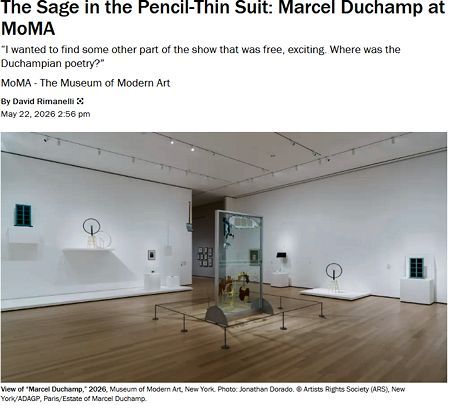 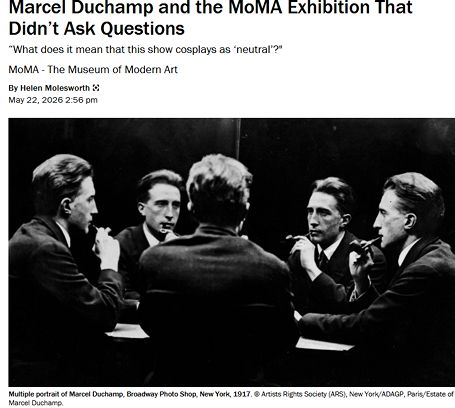
It was in the wee-hours that I read the two reviews, written by David Rimanelli and Helen Molesworth and published yesterday at artforum.com, of the Marcel Duchamp exhibition currently at MoMA. There's a lot there that behooves me to unpack (over the coming days and weeks), beginning with two items in Molesworth's review:
"Fifty years is a long time, and the labor of the three MoMA curators—Matthew Affron, Michelle Kuo, and Ann Temkin—is heroic." Correction: Dr. Matthew Affron is the Muriel and Philip Berman Curator of Modern Art at the Philadelphia Museum of Art, and, unless the situation has actually changed, hopefully this misattribution is not repeated in print.
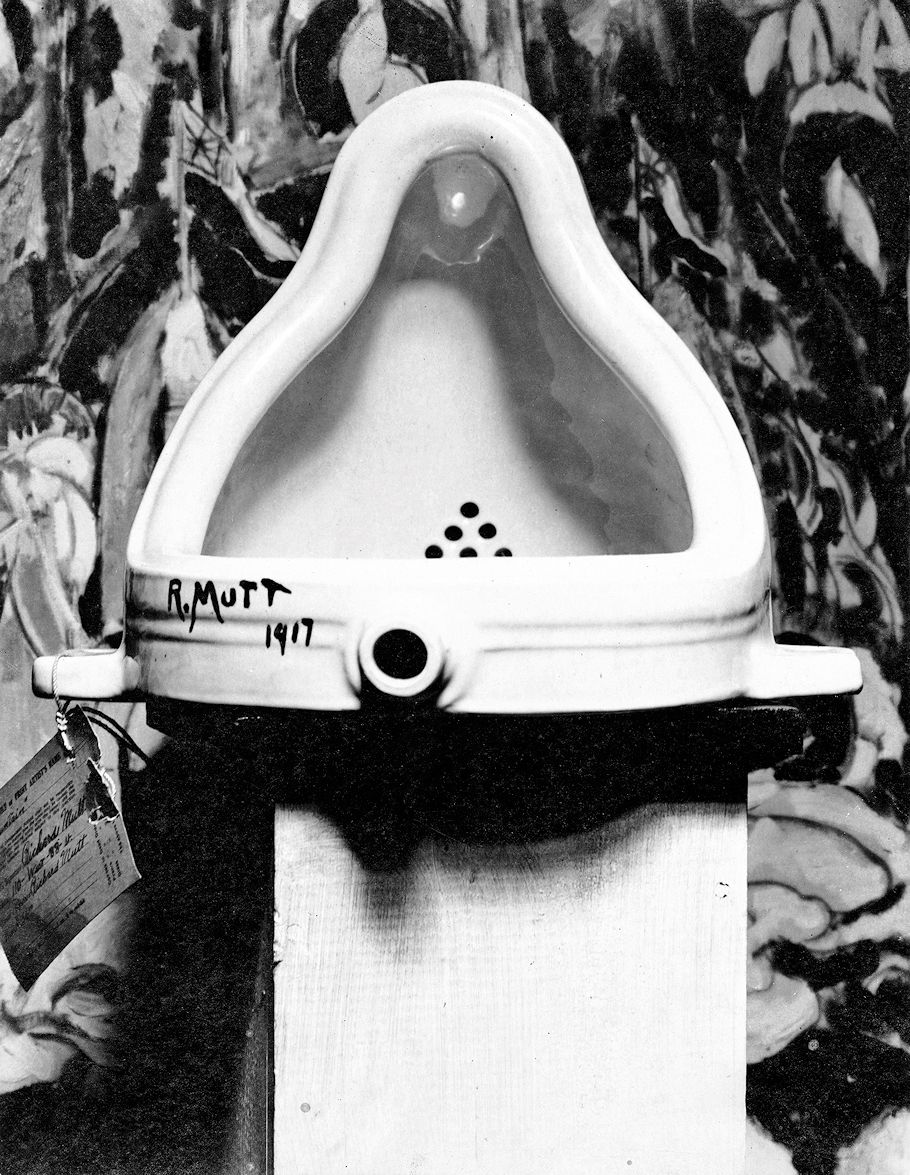
Within Molesworth's second paragraph we read: "In 1917, Duchamp bought a urinal, titled it Fountain, signed it with a pseudonym, and submitted it to a New York exhibition by the recently formed Society of Independent Artists. ... The ambivalent object ends up behind a partition before it is taken away and put on a plinth in front of a Marsden Hartley painting, where it is photographed by Alfred Stieglitz." Since Stieglitz photographed a/the urinal without a signature and date written on it--"R. Mutt 1917" was painted or penned upon the Stieglitz photograph (and not upon the photographed urinal itself)--it is incorrect to say that Duchamp submitted a signed urinal to the Independent Artists exhibition. Furthermore, in a letter to his sister, Suzanne Duchamp, dated 11 April 1917 (two days after the initial private viewing of the Independent Artists exhibition), Duchamp wrote: "Tell the family this snippet: the Independents opened here with enormous success. A female friend of mine, using a male pseudonym, Richard Mutt, submitted a porcelain urinal as a sculpture. It wasn't at all indecent. No reason to refuse it. The committee decided to refuse to exhibit this thing. I handed in my resignation and it'll be a juicy piece of gossip in New York."--Duchamp clearly states that someone other than himself submitted a urinal "using a male pseudonym."
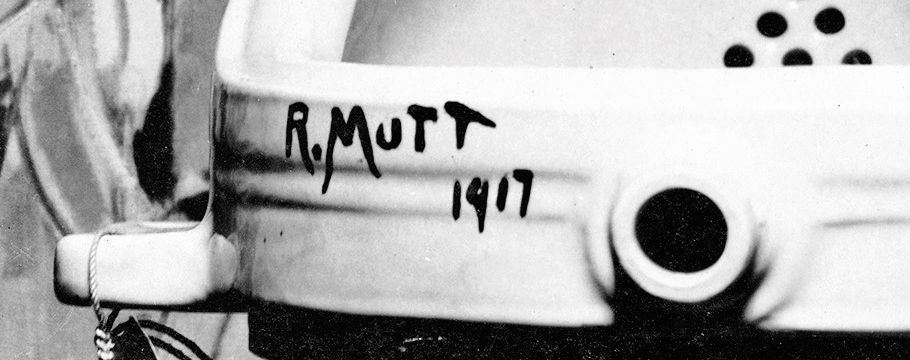
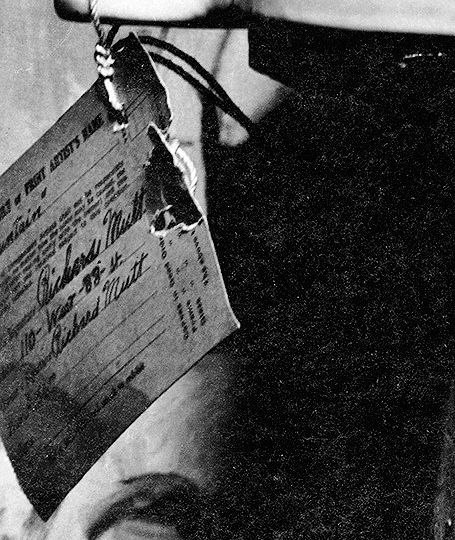
The identification card attached to the urinal photographed by Stieglitz contains the title: 'Fountain', the name of the artist: 'Richard Mutt', and the artist's address: '110 West 88th St.'. Louise Norton, author of "Buddha of the Bathroom" published within the second edition of the Blind Man, lived at 110 West 88th Street. According to the Ephemerides, on 18 April 1917, "...Marcel takes Roché for the first time to 110 West 88th Street and they spend a "beautiful night" making love with Louise Norton." On 19 April, Alfred Stieglitz writes inviting Henry McBride to call at 291: "I have, at the request of Roché, Covert, Miss Wood, Duchamp and Co., photographed the rejected Fountain ... It will amuse you to see it. The Fountain is there too." The Blind Man 2 is published 5 May 1917. On 6 May 1917, After the busy day on Friday followed by an evening at the Arensbergs', and his attendance on Saturday in the rain at the parade on Fifth Avenue, Roché went home early on Saturday night. When Marcel telephones at two in the morning inviting Roché to join him at Louise Norton's, Roché declines: he is "sleeping too profoundly". Louise Norton has commented on Duchamp's heavy drinking throughout this time.
2025.05.23
451 Rhawn Gallery

where things can get real phoney

part one of Black and White and Black and White and Color

Sister Heidi Hummel and No Doubt the Artist Suffered as Well

America is . . .
2024.05.23

Throwing a Wrench in the System or De Kooning Apposing Wouldn't-it-be-funny-if-this-was-actually-Constantine's-wife-Fausta
2021.05.23

A's 58 002
2013.05.23
What are the cultural ingredients of architecture today?
Is FACTUM arte a possible proto-type of future architectural business? Like the architect could spec Duchamp Fountains for all the men's rooms to add some culture to the act of purgation.
Is the real value then in the 3D data file that tells the 3D printer what to do?
(Although I very much doubt I'll personally get to see it, nevertheless) Could someone that inherits all of Quondam's 2D and 3D file data someday in the future decide to 3D print it all out and thus make an actual Museum of Architecture?!?
note to self: rewrite my will to make sure I bequeath all of Quondam's data to an entity that has the money and operation to actually turn Quondam into a reality. I'm sure Disney could do it, but it would be funny to leave it all to China. Why am I leaning toward Dubai?
Next time someone asks me what I do, I'll tell them I'm very busy becoming posthumously famous.
2012.05.23
the ethics of parametricism/emergent architectural thought and reification
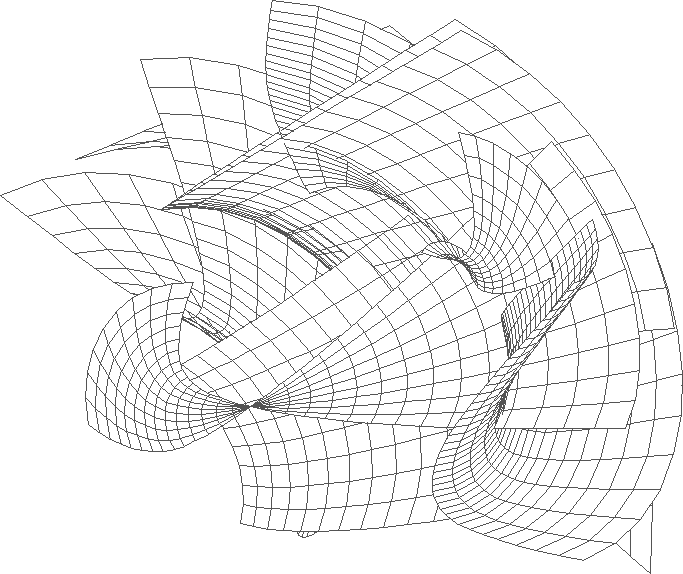
And adding to the 'unexpected' thinking, imagine the image above as the 2-dimentional 'grid' plan of a city. It's like actually stepping out of the mimicry.
What I mean here by "actually stepping out of the mimicry" is that even the image above is a form of mimicry in that it really isn't a bunch of 3-dimensional curved surfaces in space, rather a coherent group of lines that when perceived cause our brain to imagine a bunch of 3-dimensional curved surfaces in space. To see these lines as a grid plan of a city, however, you really have to adjust your imagination. And I'll say that it is within that act of "adjusting the imagination" where the crux of design happens.
I also asked, "Does it still just boil down to a sophisticated play of/with geometry?" I'd say that for the most part yes, in that the base is (many) points in space. Algorithms are used to define the surfaces between the (many) points in space. Super-fast computation puts all this sophisticated geometry in flux (and potential manufacture). Script writing, or lets say the process, is here a continual "adjusting of the imagination"--literally continually adjusting the image--and that is why is it now easy to believe that process is indeed also design.
I now wonder if the process/design of parametrics is better described as 'artificial design' because it still lacks the ability to imagine itself differently than how it is programmed to imagine itself.
2005.05.23
hotrod architecture
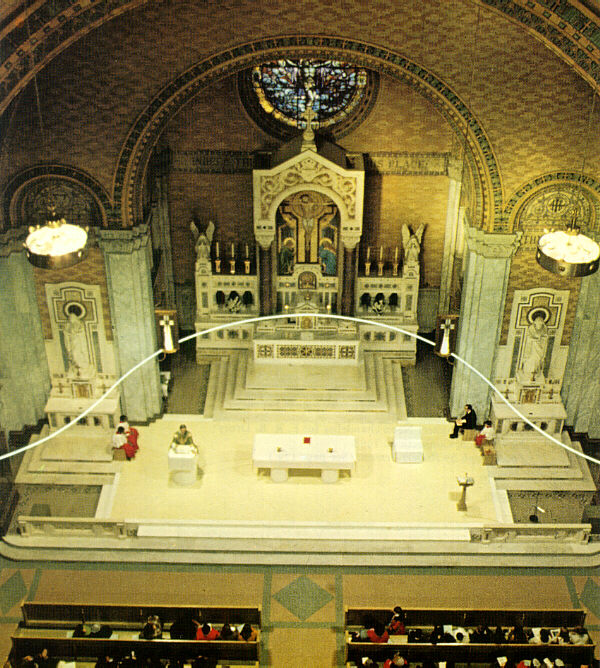
Anyone familiar with Venturi and Rauch's Renovation of St. Francis de Sales, Philadelphia 1968 (which is best illustrated in the original Learning From Las Vegas) will have to agree that it was a bone-fide "hot rod" design. Sadly, the design is no longer in place (but at least the white plastic lectern still exists, albeit in storage). The single tube of white neon that hovered over the church sanctuary apparently didn't last long at all. Like the ecumenical changes of Vatican II, the Renovation of St. Francis de Sales was indeed an "extreme makeover."
1994.05.23

Test Plot: Smell the Coffee

Test Plot: plus ignudi even
1949.05.23
1949. Monday, New York City
Following his visit to Philadelphia on 6 May, Duchamp tells Fiske Kimball that he has recounted his "mission" to the Arensbergs [8.5.1949], "describing to them as clearly as possible the spatial elasticity" of the museum. As he is unable to recall all the details, corridors and staircases, Duchamp requests photostats of sections 6 and 7, both first and second floors.
Ephemerides
1948.05.23
1948. Sunday, New York City
At nine-thirty in the morning Maria Martins and Marcel leave the city with Kiesler for a day in Connecticut to see Enrico Donati, Arshile Gorky, Yves Tanguy and Kay Sage. After lunch at the Tanguys' they play bowls on the lawn in front of the house.
Ephemerides
1947.05.23
1947. Friday, New York City
Like the previous evening, Marcel dines with the Kieslers.
Ephemerides
1917.05.23
1917. Wednesday, New York City
After lunching with Henri Pierre Roché and Marius de Zayas, Francis Picabia, the editor of 391 who is unhappy about competition from the Blind Man [5.5.1917], provokes Roché to a duel. A game of chess between the rival editors is to be decisive: Picabia is victorious, sounding the death knell for the Blind Man.
Ephemerides
|