2025.12.27
For the past two weeks or so, I've been looking through the last decade's worth of Artforum magazines in search of anything Duchamp. A week ago I found this:
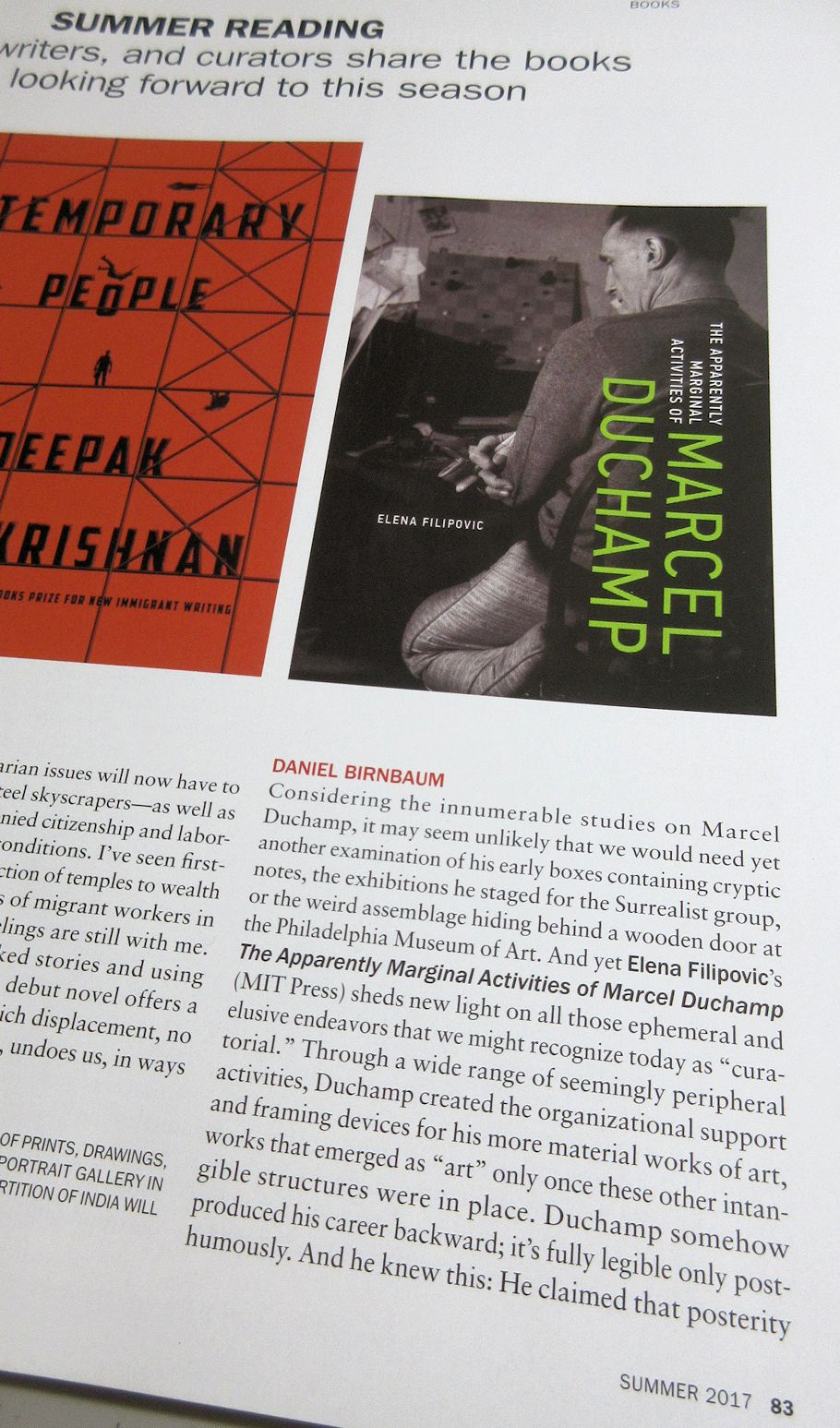
posterity...would have a word to say. I imagine Filipovic's book is the kind of posterity he was hoping for.
I completely forgot this book existed, but I certainly have to read it now, especially because of what I posted at artforum.com/talkback almost 23 years ago:
2003.01.22 13:14
Re: Favorite Artist?
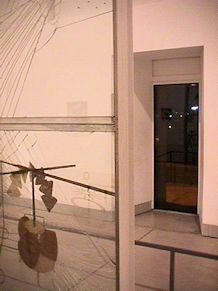
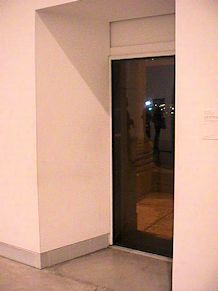
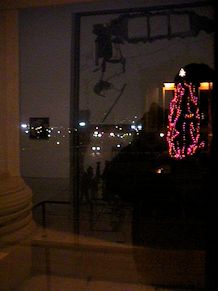
Furthermore, while everyone thought Duchamp had given up art for chess playing, he was actually being an "underground artist" (Duchamp's own term). And even further, during the early 1950s, Duchamp was arranging the Arensberg collection at the Philadelphia Museum of Art, a collection that includes the largest collection of Duchamp works anywhere. Thus Duchamp literally arranged the bulk of his own work within a major museum, including the covert Étant donnés.
Duchamp is both literally and figuratively a very good aperture through which to view 20th century art.
Arranging one's own art work within a museum, what a virtually interesting idea. Perhaps even worth reenacting.
2003.01.22 15:10
Re: Favorite Artist?
Be sure to read, if you haven't already done so, the text Duchamp prepared and read for the panel discussion "Where do we go from Here? at Philadelphia, 20 March 1961. This text is within the "Ephemerides..." of Hulten et al, Marcel Duchamp: Work and Life, 1993. It is at the end of this speech/text that Duchamp states, "The great artist of tomorrow will go underground."
Given that we now know that Duchamp was secretly working on Étant donnés at that time, it seems only natural to assume that Duchamp was indeed clandestinely referring to himself. Not only was Duchamp good at reenacting, he got pretty good at preenacting as well.
Duchamp, an underground artist predicting the future greatness of himself. How artistic can you get[?]!
2024.12.27
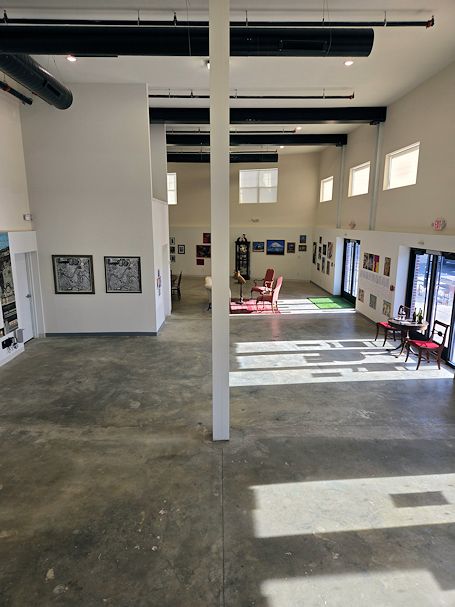 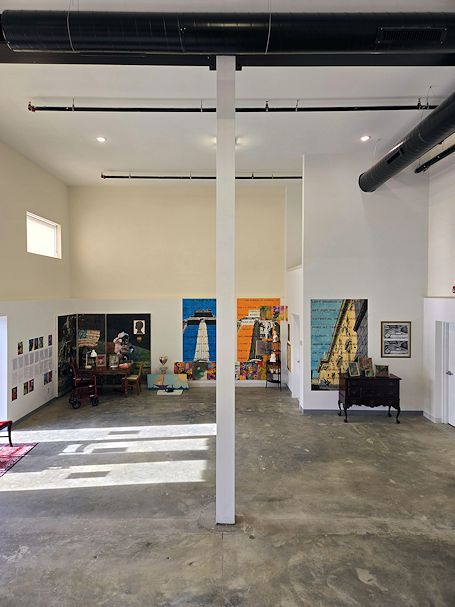
451 Rhawn Gallery
2022.12.27
From The Discovery of Piranesi's Final Project
27 December 2022 Tuesday
"Even when his mission was only to inspect, the pope's visits showed his determination to encourage and monitor the pulse of Rome's artistic industry. His visit to the bronze-founder Francesco Righetti in October 1782 is a case in point, Having recently named Righetti to his private Guardia del Corpo, Pius [VI] scrutinized numerous reductions of famous sculptures for foreign clients (including Duquesnoy's St. Susanna) destined for Holland. After inspecting more statuettes in the sculptor's inner workroom, the pope allowed the entire staff to kiss his foot and declared his happiness "at seeing the fine arts flower again in his realm, at exactly the time of his glorious pontificate." Pius proceeded next to the "Studio e Museo" of Francesco Piranesi, where he satisfied his "noble genius" by observing not just precious antiquities but the ample volumes of new engravings that would soon see the light. Pius continued this pattern throughout his reign."
Jeffrey Collins, Papacy and Politics in Eighteenth-Century Rome: Pius VI and the Arts (2004), p. 72
When Pius visited the Studio e Museo, Francesco was 24 years old. Francesco was 25 years old when Pius VI gave Gustav III a tour of the newly opened Museo Pio-Clementino. And, 28 February 1785, when Bénigne Gagneraux and Francesco presented the newly finished painting, The Meeting of the King Gustav III of Sweden and the Pope Pius VI at the Museo Pio-Clementino in Rome on 1 January 1784, to Pius VI, Francesco was three weeks shy of his 26th birthday.
26 March 1785, Pius VI ordered his own autographed copy of The Meeting of the King Gustav III of Sweden and the Pope Pius VI at the Museo Pio-Clementino in Rome on 1 January 1784, which is now in Prague.
The pontificate of Pius VI, 15 February 1775 to August 1799, matches almost exactly Francesco Piranesi's career in Rome.
2019.12.27
From The Discovery of Piranesi's Final Project
27 December 2019
Discovery of the existence of two different versions of Piranesi's 'Pianta dell antico Foro Romano' within Le Antichità Romane Vol. 1 occurred around twenty past eight on the evening of 27 December 2019.
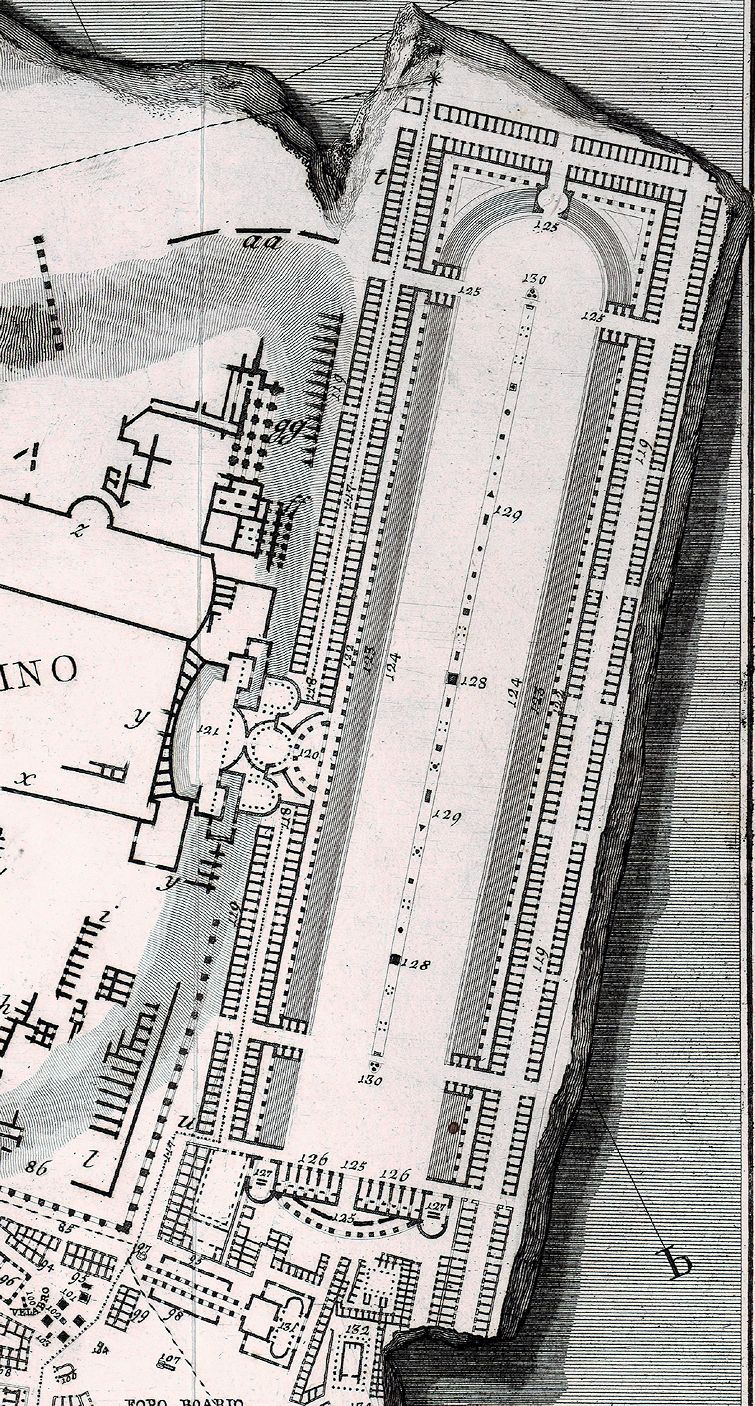 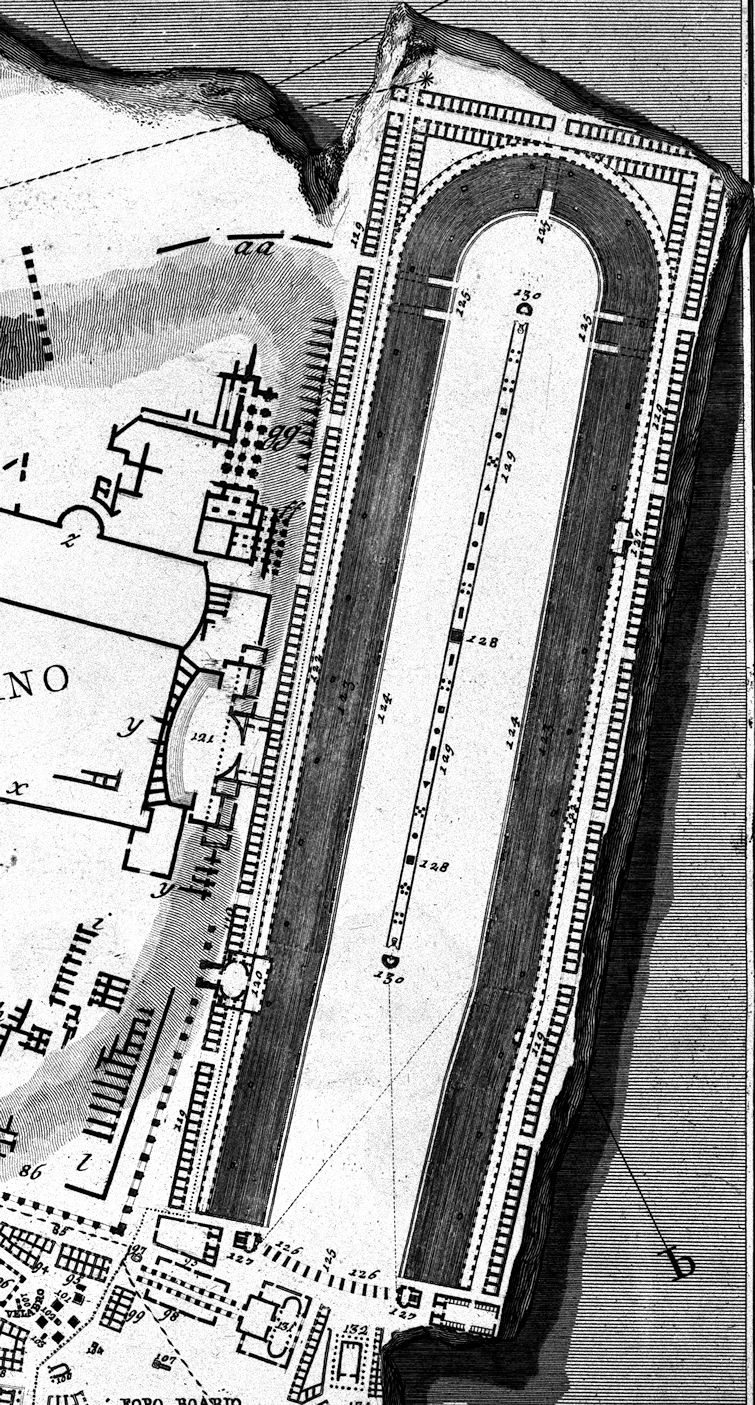
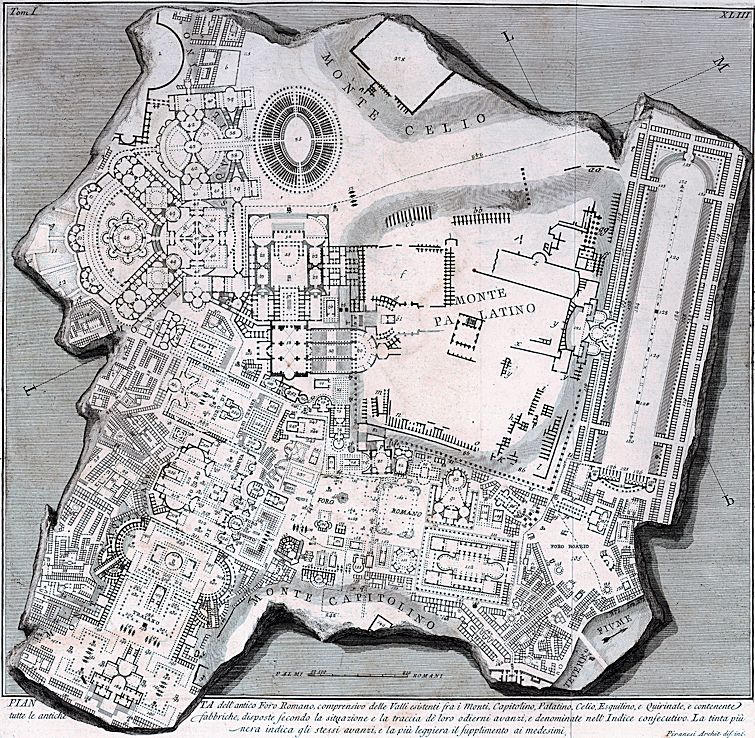 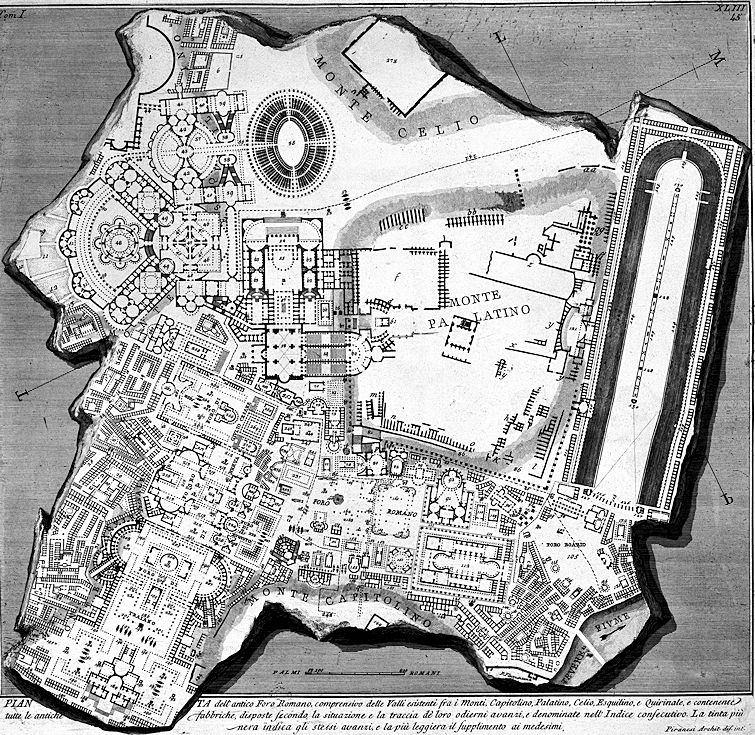
This is the second time a heretofore unknown second state printing of a Giovanni Battista Piranesi work has been declared by Quondam. That the changes made to the Circus Maximus within the Pianta dell antico Foro Romano are virtually identical to the changes made to all the circuses within the two Ichnographia Campus Martius is obviously not mere coincidence. No doubt speculation and investigation now commences. Indeed, there is already circumstantial evidence pointing to Francesco Piranesi's possible involvement.
2015.12.27
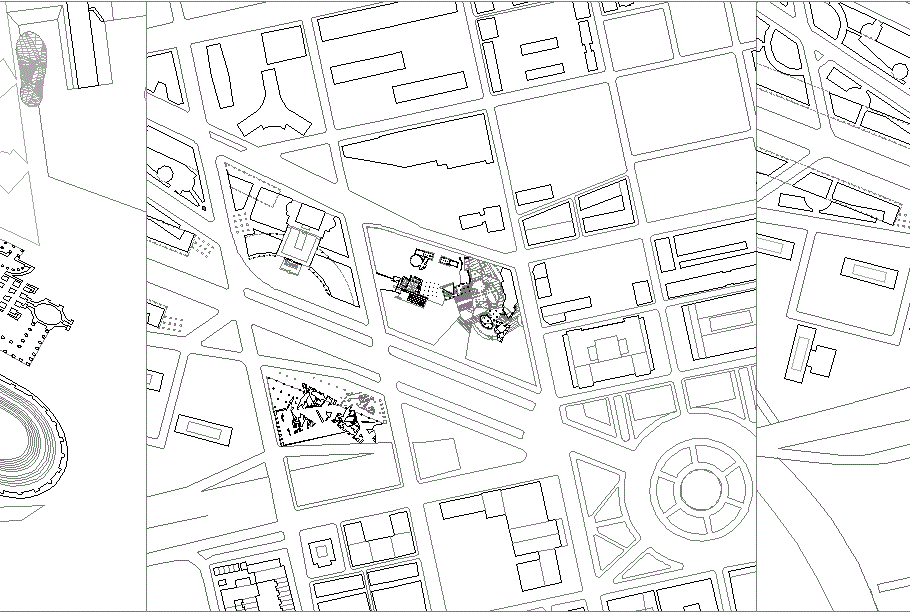
15122701.db Acropolis Q on the Parkway site plan museum compilation
2012.12.27
27 December
It was wrong to not superimpose the circus of the Sessorian district over the Ludus Florae.
Finished watching Visconti's L'Innocente Tuesday night, and watched von Trier's Melancholia last night--strange to see two movies but only hear one soundtrack.
Strange too was that dream last night--ancient Egyptian graffiti portending Johnson's rescue of Mies while also manifesting factual evidence that Akhenaten and Quondam are the same thing leading then to a critical confrontation at the bench tree of the cow pasture high point.
2011.12.27
What is Architecture nowadays?
Modern Post [and Beam]
[Ph]D Construction
Envelope of the Politics
Mini-Meism
"Brother have you got a dime-a-dozen?"
not want, not waste, thinking wishful
Theory is death backwards.
2010.12.27
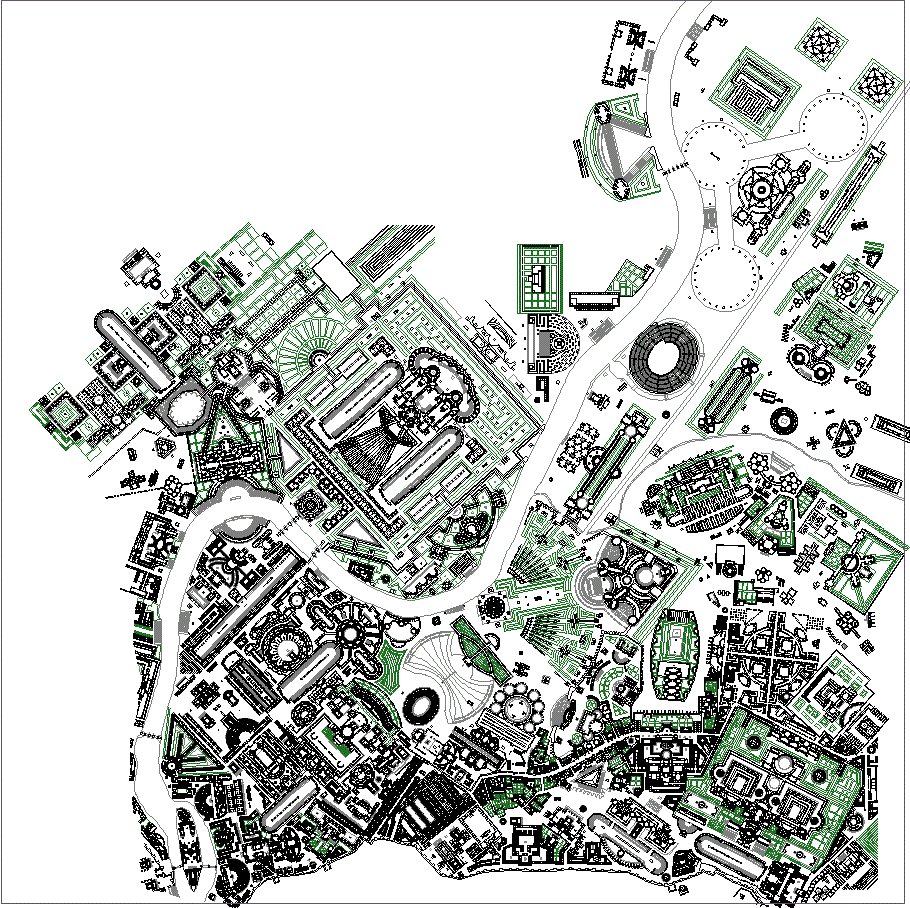
10122702.db CAD redrawing of Piranesi's Ichnographia Campus Martius complete
2002.12.27
Re: WTC design reflections
Ah, to recapture those views, if only in memory (theater) right now. Can anything short of strict reenactment of the tower(s) again provide the same sensation of being atop an enormous(ly ideal) architectural pylon?
Foul Perfection
D. Diederichsen's review of Mike Kelley's (forthcoming book) Foul Perfection in Artforum January 2003 contains a poignant Kelley quotation:
"Official art culture is much more effective in its control of history than Republican strategists, for it knows that the best way to treat contradictory material is not to rail against it, but simply to pretend it didn't happen."
I like this quotation because it provides a clear indication of what real/true history comprises.
Diederichsen's review overall hinges on the polemics(?) of an artist being both inside and outside the art (history) realm. It is worth noting, however, that this same condition is expertly addressed within the first chapter of Huizinga's Homo Ludens: A Study of the Play Element in Culture, specifically where Huizinga addresses the role of the "spoil sport" within play. For example,
The player who trespasses against the rules or ignores them is a "spoil-sport". The spoil-sport is not the same as the false player, the cheat; for the latter pretends to be playing the game and, on the face of it, still acknowledges the magic circle. It is curious to note how much more lenient society is to the cheat than to the spoil-sport. This is because the spoil-sport shatters the play-world itself. By withdrawing from the game he reveals the relativity and fragility of the play-world in which he had temporarily shut himself with others. He robs play of its illusion--a pregnant word which means literally "in-play" (from inlusio, illudere or inludere). Therefore he must be cast out, for he threatens the existence of the play-community. . . . In the world of high seriousness, too, the cheat and the hypocrite have always had an easier time of it than the spoil-sport, here called apostates, heretics, innovators, prophets, conscientious objectors, etc. It sometimes happens, however, that the spoil-sports in their turn make a new community with rules of its own. The outlaw, the revolutionary, the cabbalist or member of a secret society, indeed heretics of all kinds are of a highly associative if not sociable disposition, and a certain element of play is prominent in all their doings.
1952.12.27
1952. Saturday, New York City
In reply to Marceau's cable [23.12.1952], Duchamp announces: "Will arrive Milford before noon Tuesday stop expecting to ride back on truck bonne année.
Ephemerides
1950.12.27
1950. Wednesday, New York City
At three-thirty in Los Angeles, California, as president of the Francis Bacon Foundation, Walter Arensberg signs the agreement presenting the Louise and Walter Arensberg Collection to the Philadelphia Museum of Art. Louise Arensberg witnesses her husband's signature and the director, Fiske Kimball, witnessed by Julius Ziegst, signs on behalf of the museum. The Foundation agrees to keep the collection until space is available in Philadelphia to receive it and not to remove it from 7065 Hillside Avenue without written permission from the museum. The museum has agreed that the collection will be shown in specific galleries on its own for a period of not less than twenty-five years.
Cock-a-hoop, Kimball sends an ecstatic cable from the Bel-Air Hotel to Henri Marceau in Philadelphia.
Ephemerides
As soon as they returned to the hotel Fiske wired the Museum: "Hooray, hooray for Mr. A. Contract signed, sealed and delivered."
Triumph on Fairmount, p. 276
|